Ferrari Hypersail up close: an impressive hull and surprising details


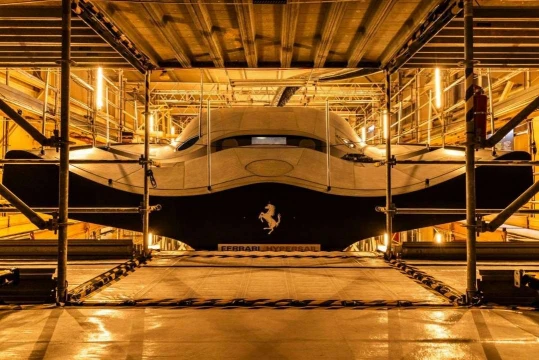
Seen from the stern, Ferrari Hypersail is impressive: its 100 feet of length, just over 30 metres, and maximum beam of almost 8 metres take on a different scale when you stand in front of the boat, now nearing completion and surrounded by scaffolding. The eye runs along the hull and up towards the deck, trying to take in proportions that even those familiar with maxi yachts need time to get used to. Once on the water, the overall width including the appendages will be around 20 metres: a figure that helps to picture how much space this monohull will occupy when it can finally spread its wings. It should be noted, however, that under sail only one of the arms will be in the water, while the windward one remains raised.
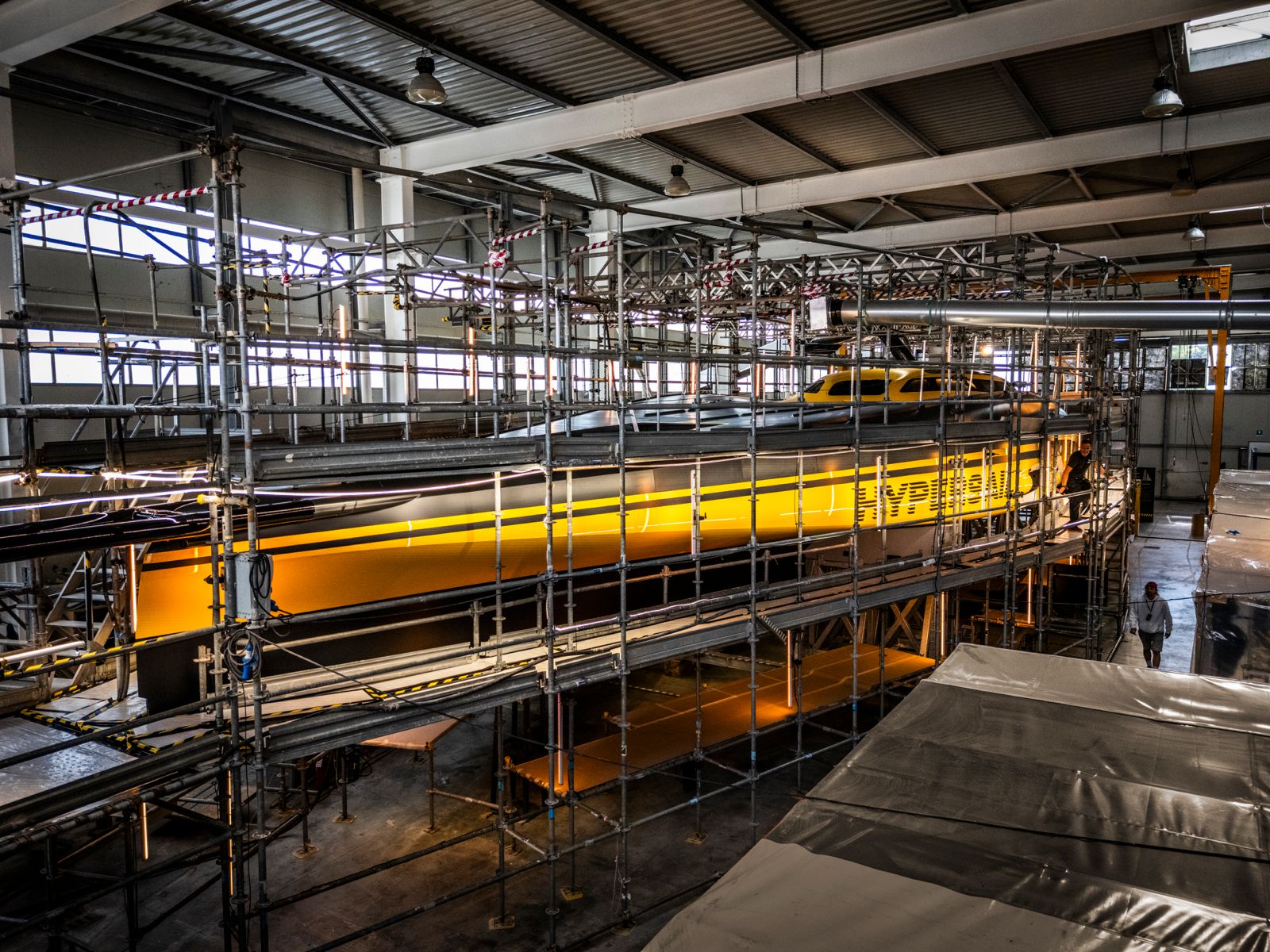
We had the opportunity to visit the yard and see Ferrari Hypersail up close at this stage of construction, with the painting and hull livery completed. Climbing the scaffolding that surrounds it, the impact of its size is joined by the pleasure of discovering its details. Up close, one can appreciate the refinement of the workmanship and the care with which every element has been built on a boat that will have to withstand the stresses of ocean sailing while maintaining the precision required for flight.
It is a true masterpiece of boatbuilding. This can be said without being swayed by the Prancing Horse on the stern: it is enough to linger on the surfaces, follow the shapes and observe how such a complex project has actually taken shape. For those who love boats and how they are built, seeing it at this stage is a privilege, as it reveals details that will be much harder to observe once it is in the water. The deckhouse is fully enclosed and aerodynamic, and the Hypersail grey in which it has been painted makes it even more striking: it looks like a submarine, yet it will fly above the waves. Particular attention has been paid to aerodynamics in flight: an F1-style wing is planned at the stern, but its task will be to increase lift, not downforce.
The visit continued in a separate shed, where the appendages are on display: the foils, the rudder with its elevator, and the keel. Here it is above all the finish of the surfaces designed to work in the water that draws attention. The mirror-polished stainless steel and the foil trailing edges, less than a millimetre thick, immediately convey the level of precision achieved. Seen up close, these parts show how Italian engineering and manufacturing can perform at the highest level. Their beauty also stems from an awareness of the task that awaits them. It is these surfaces that will support the boat and transmit sailing loads to the structure. On a flying ocean-going monohull, every detail of the profile and every adjustment contributes to the behaviour of the whole.
The design provides for three points of support in flight: the leeward lateral foil, the horizontal appendage of the rudder and the foil integrated into the canting keel. The latter is one of Hypersail's most original solutions and is fitted with a flap, a movable surface that makes it possible to modulate its contribution to lift and to the boat's balance. Seeing these components separately from the hull conveys their shapes and complexity far better than an image of the complete boat could.
The quality of the appendages must be matched by that of the structure supporting them: at the points subject to the highest loads, including the foil arms and the mainsheet traveller, components with a sandwich structure combining layers of carbon and titanium are used. This solution brings experience gained by Ferrari on its sports cars into boatbuilding and meets the need to limit weight while maintaining stiffness and strength.
Structural precision also plays an essential role in the operation of the Flight Control system. We had already examined the energy architecture and onboard systems in PressMare; standing in front of the appendages, their connection with the mechanical side becomes easier to grasp. Sensors, computers and actuators must work with surfaces able to respond faithfully to the required corrections as speed, trim and sea conditions change. The automated system will handle flight adjustments and, above all, onboard energy management – which does not involve fossil-fuel generators – leaving the crew to sail the boat and make navigation decisions.
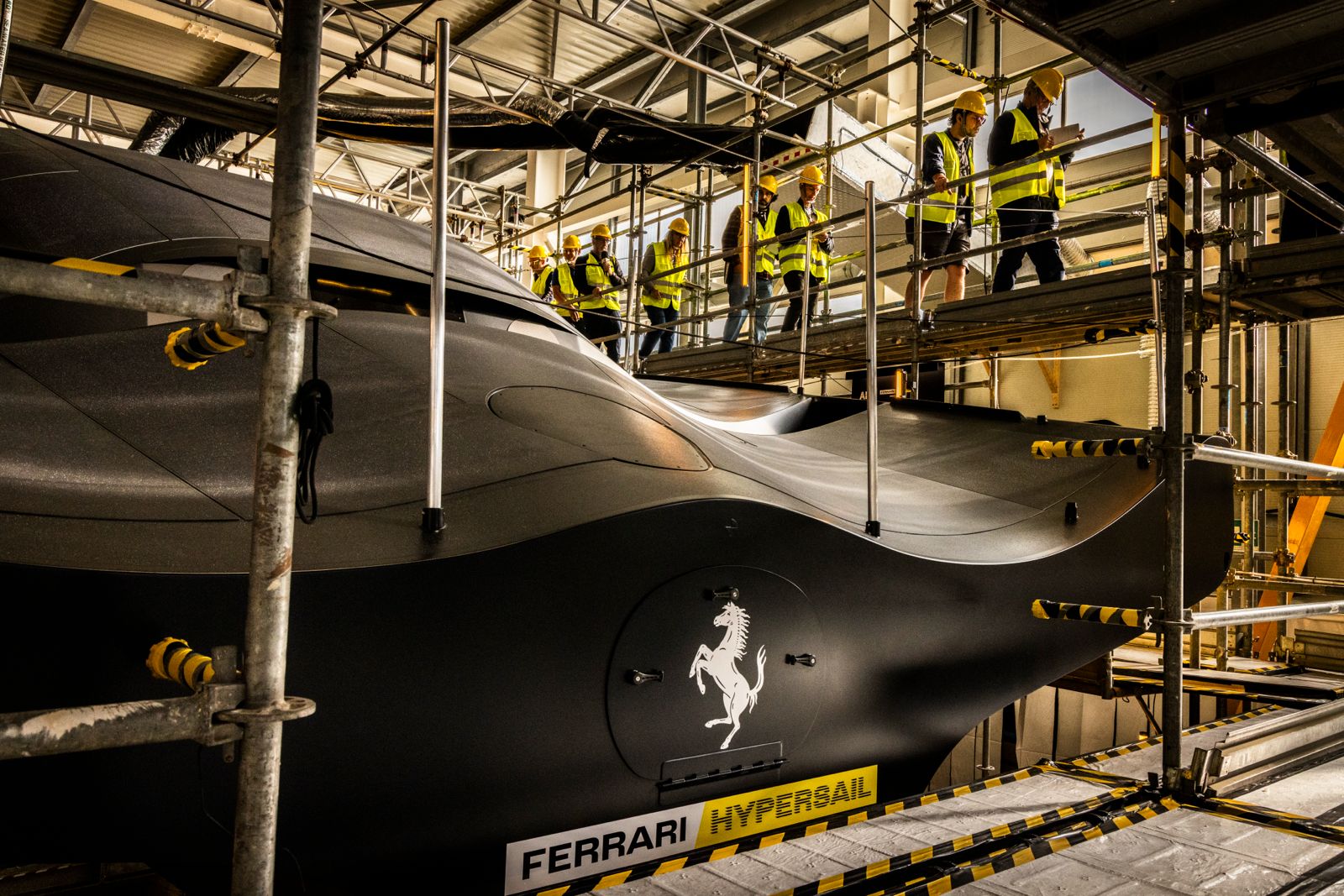
Development of Hypersail has meanwhile passed the mark of twenty patents. Among the solutions mentioned by Ferrari are a rotating mast fitted with alulae, small aerodynamic surfaces, and a double-skin mainsail similar to those used in the America's Cup. These elements add interest to a project of which much remains to be discovered and, above all, tested at sea. On this subject, we discussed the timeline with team leader Enrico Voltolini in a video interview that we will publish shortly.
Leaving the yard, however, one's thoughts return to the view from the stern and to the appendage surfaces observed from a few centimetres away. Having followed its drawings, simulations and technological development, seeing Hypersail almost complete stirs a particular emotion. There is the desire to see it sail, of course, but also the satisfaction of having been able to observe at close range the work of those building such an ambitious boat.
Giuliano Luzzatto
©PressMare - All rights reserved