Mercury 300 HP: Five Outboards, One V8 Engine


The Italian outboard engine market is going through a phase in which higher horsepower ratings are gaining importance, not only in terms of performance but also because of the commercial value of these propulsion systems and the technologies they bring on board. The 300 HP and above category is currently one of the most interesting segments: over the past twelve months, it reached a record 1,100 units sold, within an overall outboard market exceeding 19,000 units. Mercury covers this segment with a range extending from 300 to 600 HP and, right at the entry point, offers an interesting feature: five different interpretations of the same powerhead, intended for applications ranging from recreational boating to commercial operations and high-performance use.
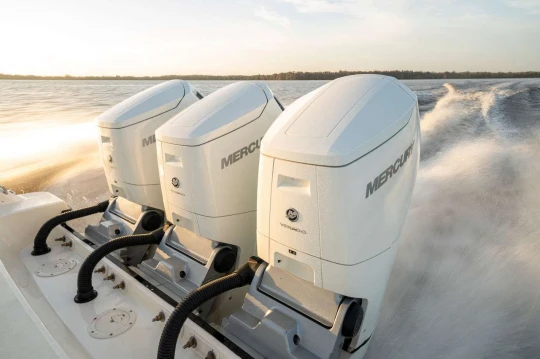
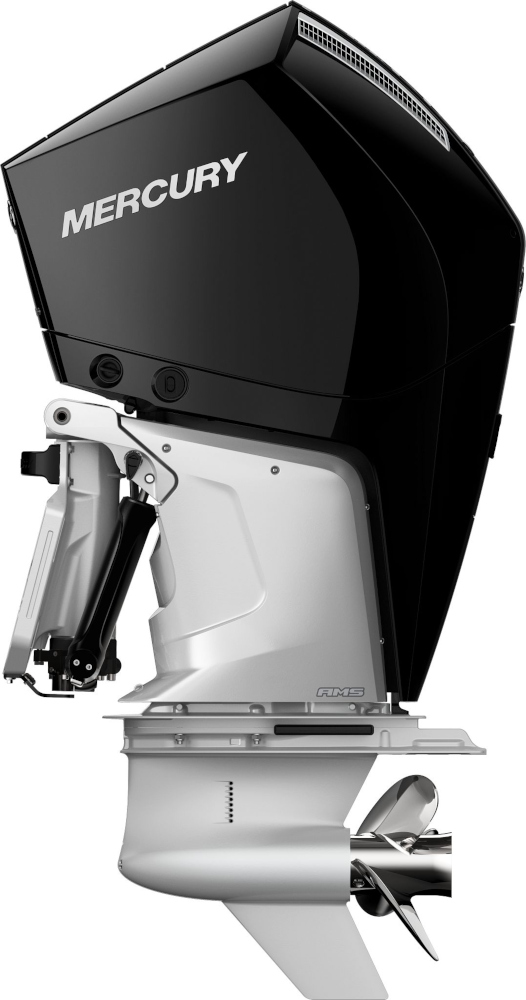
The common foundation is a naturally aspirated 4.6-litre, 279-cubic-inch V8, with a 64° bank angle, dual overhead camshafts and 32 valves. Bore and stroke measure 92 and 86 mm respectively, while the wide-open-throttle operating range extends up to 6,200 rpm on the Racing version. The engine block is die-cast from XK360 aluminium-silicon alloy with a low copper content, while a balance shaft helps reduce noise and vibration. The exhaust architecture is also noteworthy: the manifold is positioned inside the V and runs down the engine’s centreline, helping to reduce its overall width. As a result, the outboards can be installed with centre-to-centre spacing of approximately 66 cm, an important characteristic particularly when two, three or more engines need to be accommodated on the transom.
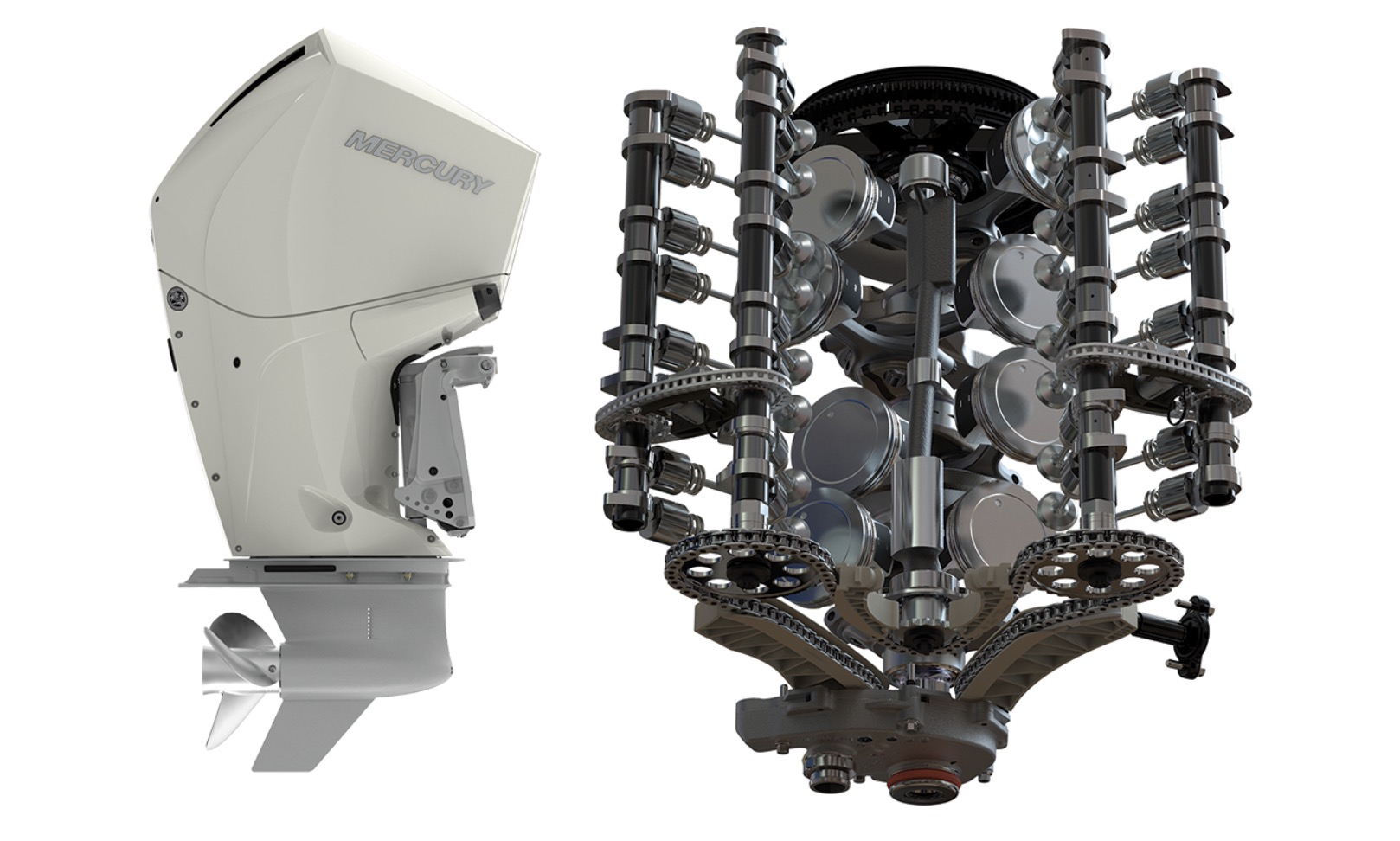
Fuel delivery is handled by an electronic multipoint Port Fuel Injection (PFI) system: each cylinder has its own injector, which sprays petrol into the intake port upstream of the valves, rather than directly into the combustion chamber as in direct-injection systems. The fuel therefore mixes with the air before entering the cylinder. Engine management is entrusted to the SmartCraft PCM 112 (Powertrain Control Module), which processes sensor data and controls parameters such as fuel injection, throttle opening and ignition timing. The latter is managed through a digitally controlled inductive ignition system, which electronically determines when the spark plugs fire. The system also includes ARO (Advanced Range Optimization), which adjusts engine parameters under steady-state operating conditions to reduce fuel consumption and extend cruising range, and Transient Spark, which temporarily modifies ignition timing during acceleration to improve throttle response and increase low-rpm torque, with a claimed improvement of around 5–7%.
Starting from this extensively shared mechanical platform, Mercury has therefore developed five 300 HP outboards with different characteristics and intended applications. To understand where the similarities end and, more importantly, where the differences begin, PressMare spoke with Stefano Arrigoni, Mercury’s After-Sales Manager, during the Genoa International Boat Show, examining the FourStroke 300, Verado 300, Pro XS 300, Mercury Racing 300R and SeaPro 300 in detail.
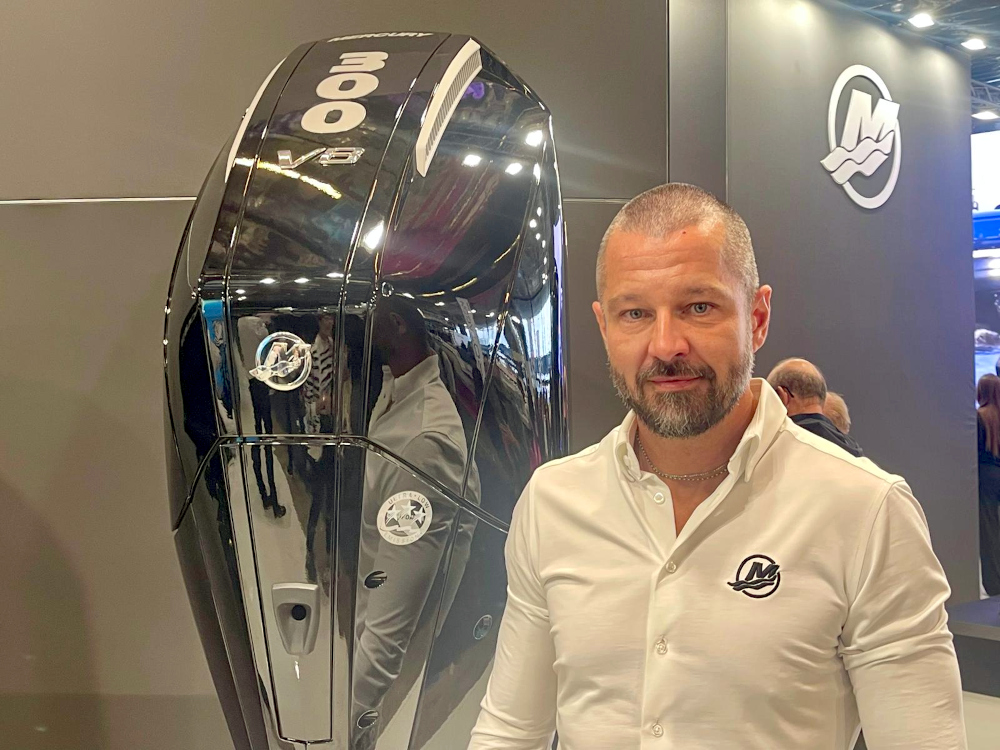
PressMare – Let’s start with what are probably the two best-known and most widely sold models, the FourStroke and Verado. What are the differences?
Stefano Arrigoni – They are also our two best-selling models. The gearcases are essentially similar, but they use different gear ratios: 1.75:1 for the FourStroke and 1.85:1 for the Verado. The latter therefore uses a slightly higher reduction ratio, meaning that at the same engine speed the propeller turns more slowly, allowing its characteristics to be matched to the application. With the correct propeller selection, outright performance remains essentially equivalent. The main difference concerns the midsection: the Verado features integrated electric steering, an eight-point engine mounting system designed to minimise vibrations transmitted to the boat, and an adjustable exhaust system that allows its sound to be modified. The FourStroke uses a more conventional solution and dispenses with some of these features, keeping the price down and making it particularly attractive for repowering applications.
PM – So, in terms of outright performance, the Verado does not necessarily offer anything more than the FourStroke?
SA – No. We have carried out comparative tests and, under identical conditions with the appropriate propellers, the results are equivalent. What changes most is the driving experience: the Verado offers greater comfort in terms of noise, vibration and steering response. It should therefore not be regarded as a faster FourStroke, but as a more refined solution in these respects.
PM – Let’s move on to the Pro XS 300. What changes?
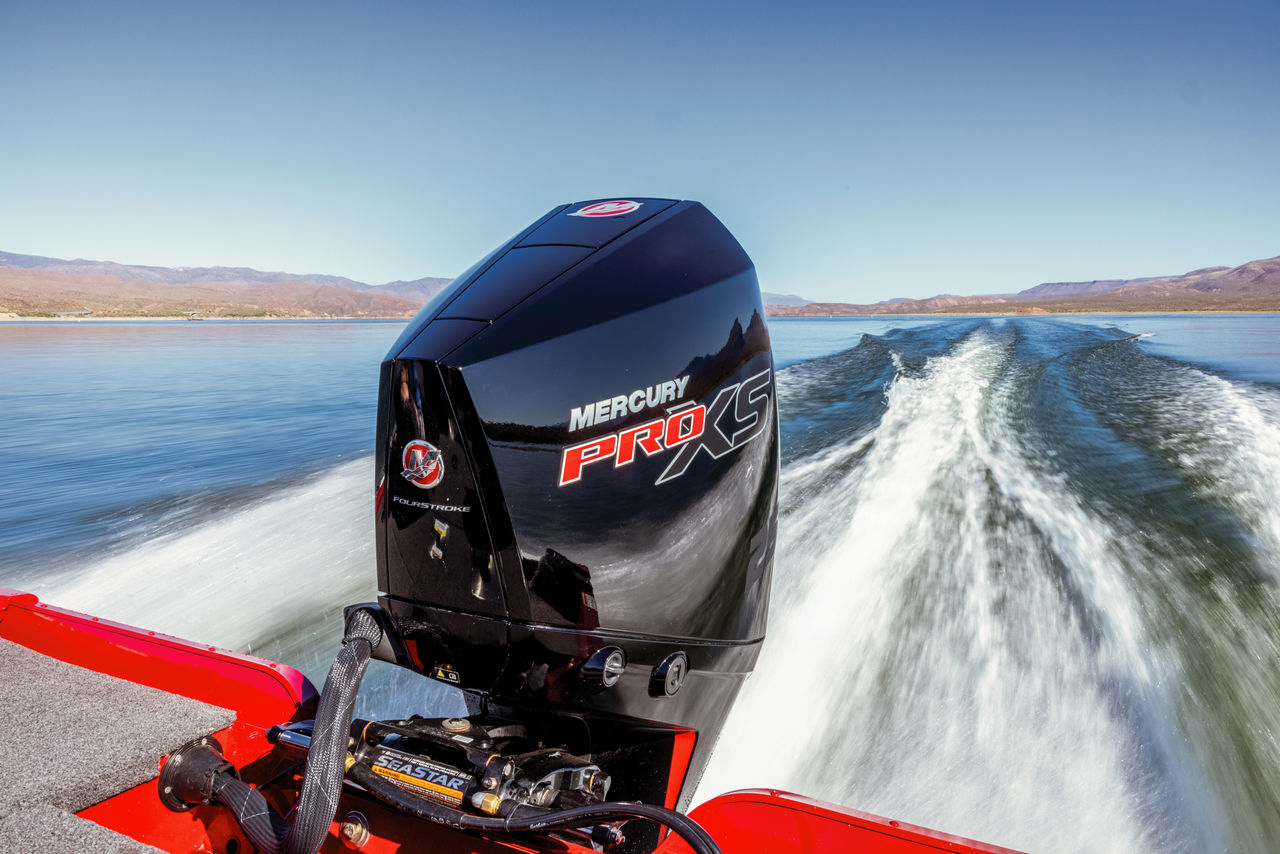
SA – The Pro XS retains a conventional midsection, but its distinguishing feature is the TorqueMaster gearcase, developed for high-performance applications and to allow the outboard to be mounted higher. It has a 1.75:1 gear ratio and a reinforced propeller shaft measuring 1.25 inches, or 31.75 mm, in diameter. It can operate with the propeller partially surfacing and, by reducing the submerged portion of the gearcase, decreases hydrodynamic drag. On a suitable hull, this can translate into higher speed. The Pro XS was developed primarily for lightweight, sporty boats, particularly American bass boats, where acceleration, speed and trim control are critical. Its calibration is also specific: it can reach higher engine speeds than the FourStroke and Verado and provides a more aggressive response.
PM – Although originally developed for bass boats, does it also have interesting applications in Italy?
SA – We sell it very successfully here too. Consider, for example, a 7.5- or 8-metre RIB rated for a maximum power of 300 HP: if the hull has a sporty design and allows the outboard to be mounted higher, the Pro XS can deliver a few additional knots compared with a conventional solution. Naturally, weight, hull geometry and intended use must always be considered: it is not a suitable choice for every boat.
PM – Does the Mercury Racing 300R take things a step further towards more extreme applications?
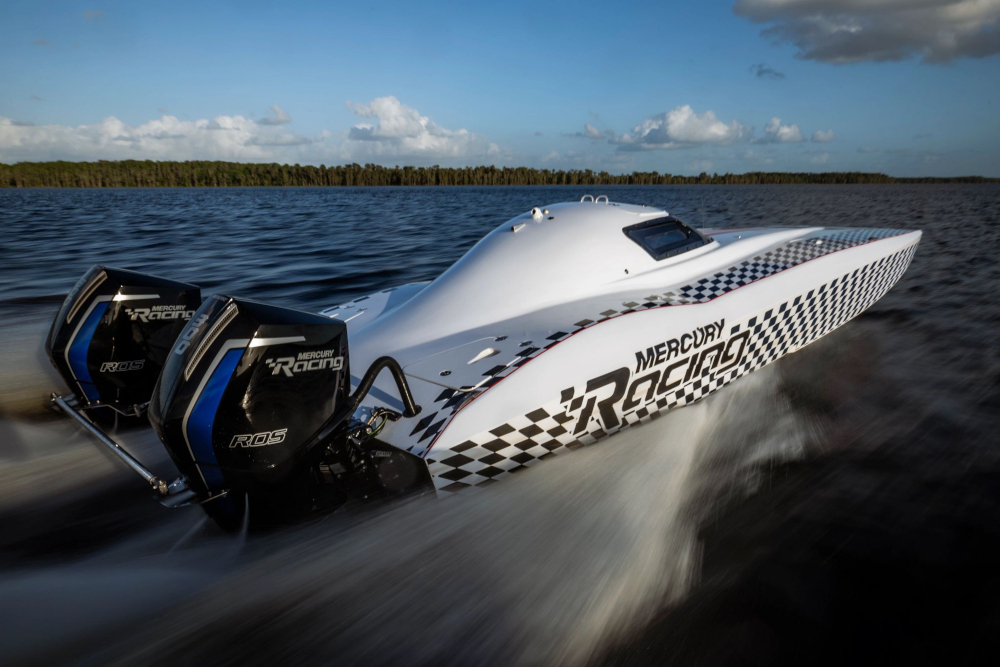
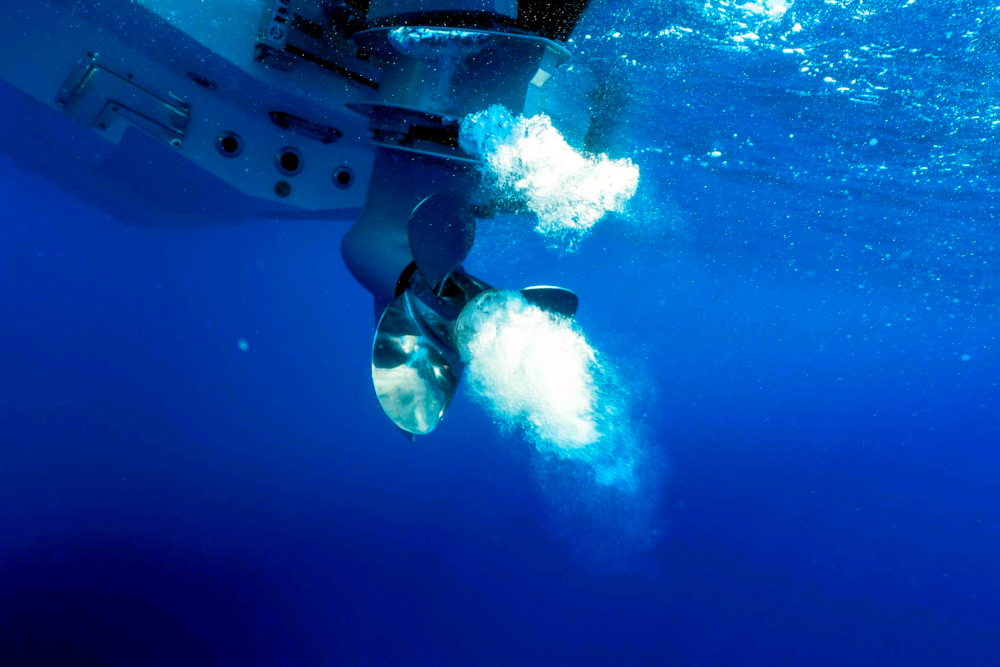
SA – Exactly. The 300R has a more robust midsection, engineered to withstand the loads associated with high-performance applications, and above all uses the Sport Master gearcase, our most advanced solution for this type of use. It is designed to operate at very high mounting positions, with the propeller partially surfacing. It therefore allows more extreme installations than the Pro XS, but requires a hull specifically designed to exploit its characteristics: installing a 300R does not automatically mean achieving better performance.
PM – Under these operating conditions, propeller characteristics also become particularly important. How many blades are generally used?
SA – Specific propellers are required, generally with four or five blades. We use, for example, four-blade Ventera and Bravo I propellers, as well as cleaver designs and other five-blade models. When operating with a partially surfaced propeller, it is important that at least one blade remains submerged at all times. Increasing the number of blades makes operation smoother and distributes loads more evenly. A conventional three-blade propeller could be subjected to very high stresses, potentially resulting in damage.
PM – So it is not just a question of hydrodynamics, but also of the propeller’s structural strength. Are we always talking about stainless steel?
SA – Yes, for these applications we use stainless-steel propellers. They must be specifically designed to withstand very different loads from those experienced by a fully submerged propeller.
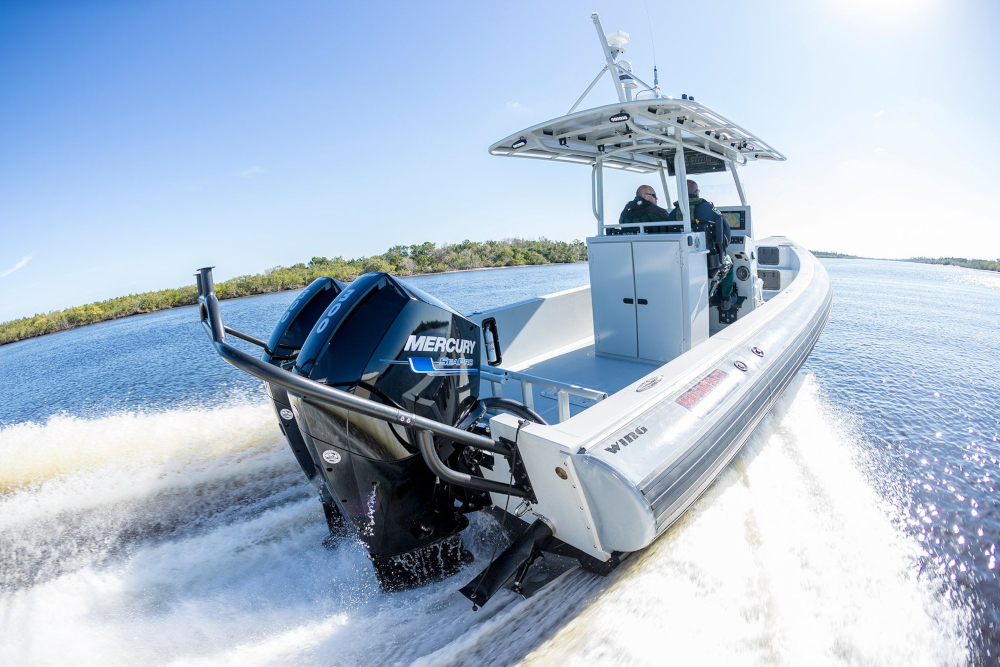
PM – At the opposite end of the spectrum in terms of intended use is the SeaPro 300, aimed at the commercial market. What changes?
SA – The SeaPro prioritises durability and reliability for operators who accumulate many hours of running time. The electronic calibration is more conservative, and maximum engine speed is lower than on the recreational versions, by approximately 200 rpm. This reduces mechanical stress and favours longevity, an important consideration for anyone who uses their boat professionally every day.
PM – Commercial fishermen, commercial operators, public authorities, but also sailing teams using RIBs and support boats?
SA – Certainly. Here at the show, for example, we saw a Coast Guard vessel equipped with a pair of SeaPro outboards. These are boats that accumulate many operating hours, where the priority is not to gain the last knot of speed but to have reliable propulsion systems for intensive use. Ultimately, that is the concept behind the five versions: the choice must be based on the boat and its actual operating requirements.
PM – What, then, are the key factors in choosing the right 300 HP model?
SA – Above all, the hull, its weight and the performance objectives. On a relatively heavy 10-metre boat, I would hardly choose a 300R or a Pro XS; a Verado or FourStroke would probably be more appropriate. On a lightweight, fast 7- or 7.5-metre RIB designed for a high outboard mounting position, however, considering the 300R may make sense. This is a principle we strongly emphasise in dealer training.
PM – So dealers must carefully assess the boat even when customers arrive having already chosen a particular model?
SA – Absolutely. We always ask dealers to find out about the boat and its intended use, because the objective should not necessarily be to sell what the customer asks for, but what the customer actually needs. For example, someone could install a 300R on a fairly heavy 9-metre boat and discover that it performs worse than a FourStroke. The racing gearcase is designed to provide directional stability and control when operating at a very high mounting position; if it remains fully submerged, however, its geometry generates greater drag and can reduce speed. Sometimes customers tell us: “I bought the 300R, but the boat doesn’t perform as I expected.” Often the problem is not the engine, but the combination.
PM – So it is wrong to make a decision based solely on horsepower or how sporty a model appears.
SA – Exactly. Some customers come in saying: “I want that engine”, but the selection criterion should be different. From a commercial perspective, it would actually be more profitable for us to sell a 300R because it costs more. But if we know it could perform worse on a particular boat than a less expensive product, we prefer to advise against it. The objective is for the customer to achieve the right result and be satisfied with the propulsion system.
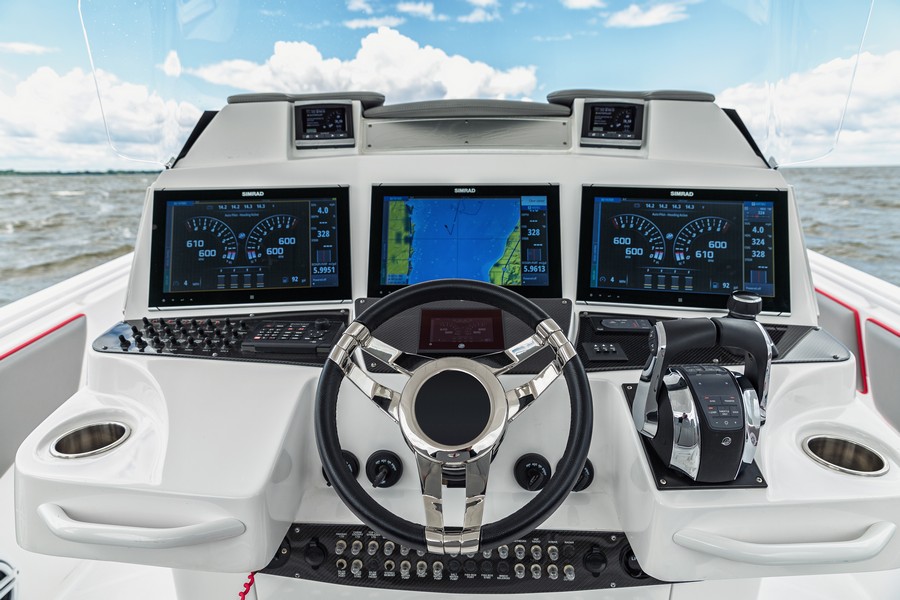
PM – Let’s turn to the helm interface. What options are available for controls and steering?
SA – The Verado is available exclusively with electronic controls, consistent with its higher level of integration. The FourStroke, Pro XS and 300R can also be configured with mechanical controls, an important option particularly for repowering projects and certain commercial applications. The engine itself is still electronically managed: when mechanical levers are used, cable movement is converted into an electrical signal by dedicated actuators. This allows a modern outboard to be installed on a boat that retains a traditional control system.
PM – The 300 HP models are increasingly used in twin, triple and multiple-engine installations. What options does the range offer?
SA – It depends on the model and the available shaft lengths. The Pro XS was primarily designed for single-engine installations, but can also be used in twin-engine configurations under certain conditions; the boats for which it was originally developed generally have relatively low transoms. The other models offer a wider choice of shaft lengths, including L, XL and XXL, allowing them to be adapted to different transom geometries and multiple-engine installations.
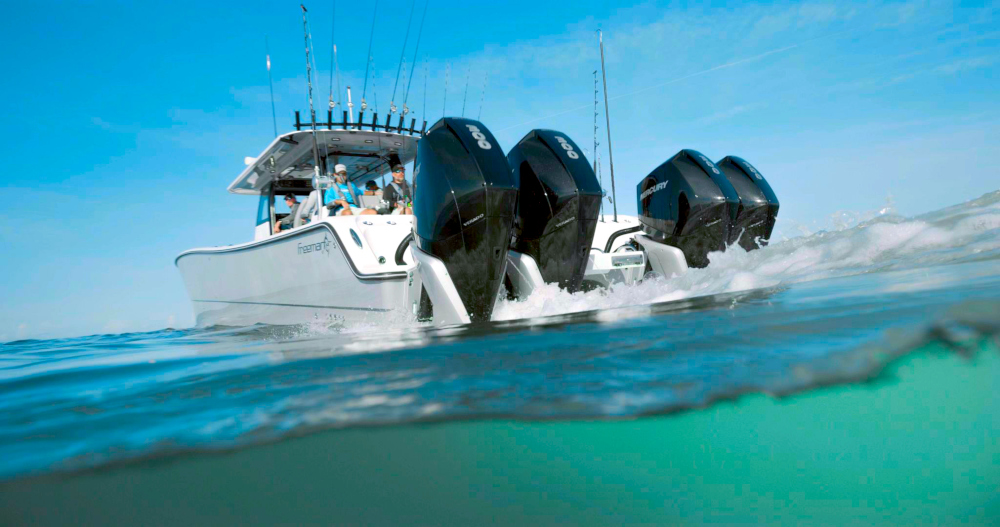
PM – And of course, counter-rotating propellers also come into play in multiple-engine installations.
SA – Certainly. In a twin-engine installation, one right-hand and one left-hand rotation propeller are generally used. In a triple installation, a common configuration uses two right-hand and one left-hand rotation propellers, although other arrangements are possible. Electronically, we can manage up to six engines through a single integrated system. Some six-engine installations from other manufacturers use two independent systems, each controlling three engines. We can instead manage all six through one electronic architecture and a dual-lever throttle control.
PM – How much demand is there for joystick control?
SA – A great deal on the Verado. Customers choosing this model are generally looking for technology, comfort and ease of use. Adoption is certainly widespread, particularly on new boats, where shipyards frequently specify it. Joystick control is not available on the FourStroke: customers who want this function must opt for the Verado, which has the necessary steering system and electronic architecture.
PM – Another element of customisation is colour. What finishes do you offer?
SA – On the European market, mainly black and cold fusion white. Additional options are available in the United States. FourStroke and Verado are offered in both finishes, as is the Racing model, while the Pro XS is available only in black.
PM – Let’s talk about maintenance. Do the sportier versions require shorter service intervals?
SA – Not under normal recreational use. For our 300 HP outboards, the standard interval is every 100 hours or once a year. Genuine competitive use of the 300R is different, with frequent operation at maximum rpm and high loads. In those cases, we recommend more frequent servicing and, under certain racing conditions, oil changes may be required every 25 hours. These are, however, specific situations that must be assessed individually.
PM – So even if 100 hours have not been reached, annual servicing is still advisable?
SA – Certainly. And the reverse is also true: if a boat accumulates 200 hours in one season, an intermediate service should be carried out rather than waiting until the end of the year.
PM – Let’s look at weight. How much do the five 300 HP models differ?
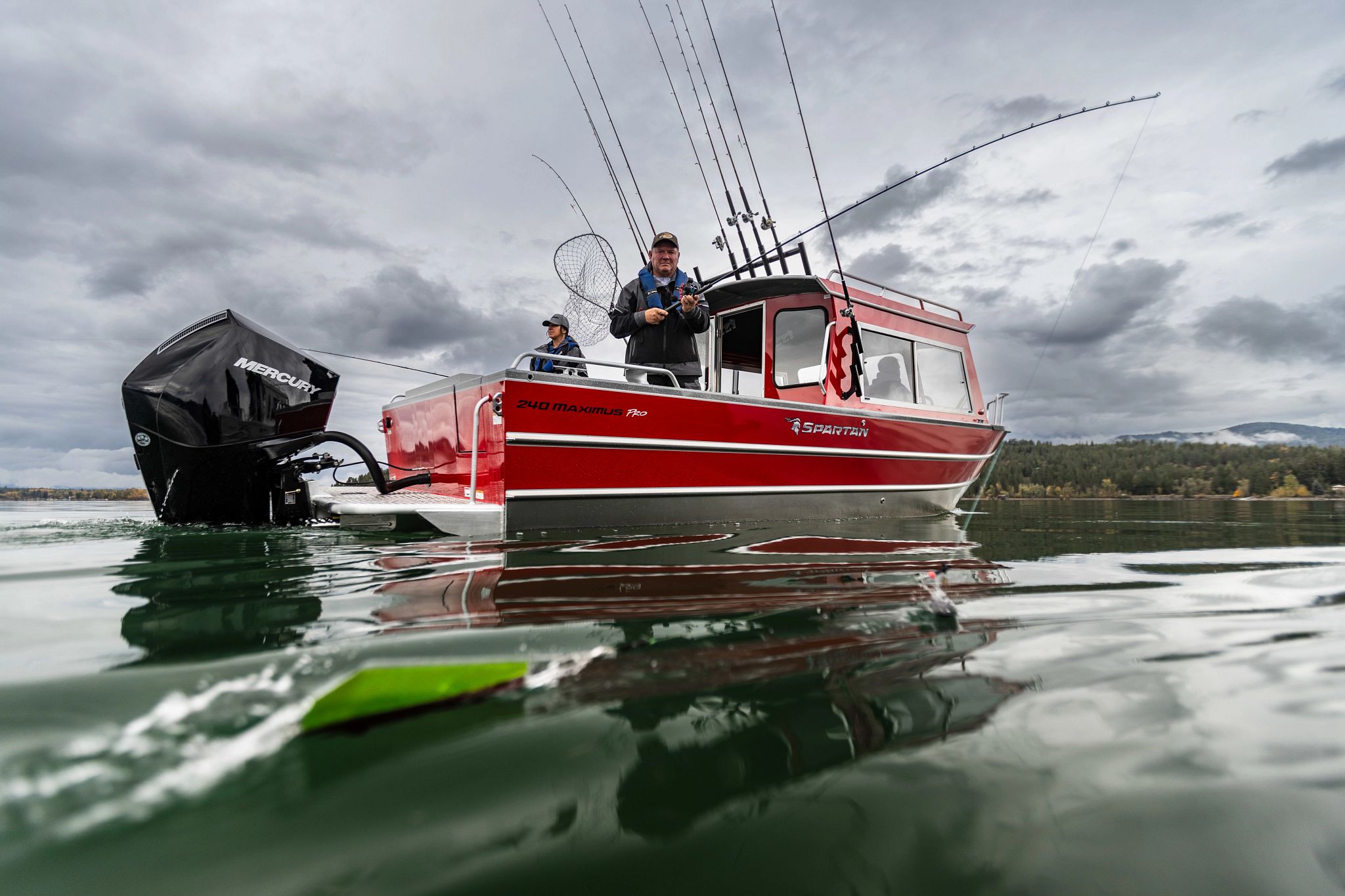
SA – The differences mainly depend on the midsection and the mounting and steering systems. The Verado, for example, weighs approximately 15–20 kg more than a version with a conventional midsection because of its more complex structure, integrated steering and vibration-reduction features. Compared with our competitors, we believe we have a significant advantage: our lightest 300 HP outboard weighs approximately 306 kg, an important figure because the entire weight of an outboard acts on the transom and directly affects the boat’s trim.
PM – However, some hulls perform better with more weight aft. In those cases, could a lighter engine become a disadvantage?
SA – Some boatbuilders raise this point with us too. My answer is always the same: weight can be added, but it cannot be removed from an engine that is inherently heavy. If a hull benefits from a few additional kilograms aft, the builder can adjust the weight distribution. If, on the other hand, the engine is already heavy and the stern needs to be lightened, there is no equivalent option. Starting with a lighter engine therefore gives designers greater freedom.
PM – And it allows any additional weight to be positioned where it is most useful for trim…
SA – Exactly. This does not mean adding weight to a boat is desirable: generally speaking, keeping displacement down is beneficial. But when weight distribution needs to be adjusted, the builder can do so in a targeted manner. On some hulls, additional weight may be placed aft; on others, the lighter outboards can be exploited directly. Reducing overall weight can naturally also benefit fuel consumption.
PM – Let’s discuss integration. Which instruments can these Mercury outboards interface with?
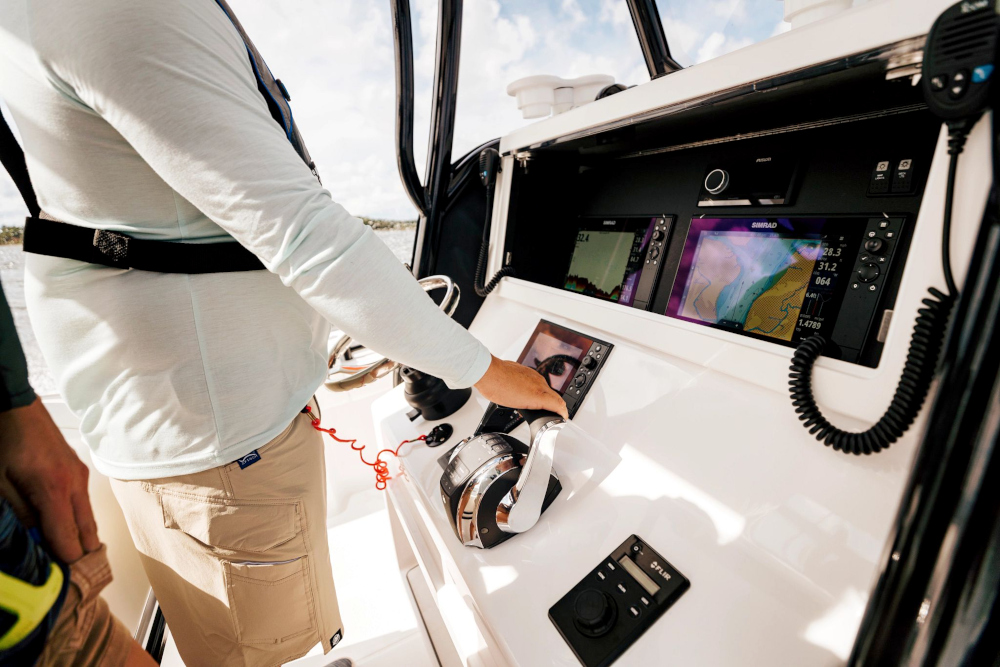
SA – We have invested heavily in the electronic integration of the helm station. Mercury instrumentation can be displayed directly on multifunction displays from the leading marine electronics manufacturers, including Garmin, Raymarine and the brands of the Navico Group – which, like Mercury Marine, is part of the US-based Brunswick Corporation – such as Simrad and Lowrance, while retaining the Mercury interface and functionality. Owners can therefore view engine data on the same screen used for electronic charting, without necessarily installing a dedicated display. This helps streamline the helm layout and provides freedom in choosing navigation electronics.
PM – Does this integration extend to manoeuvring systems?
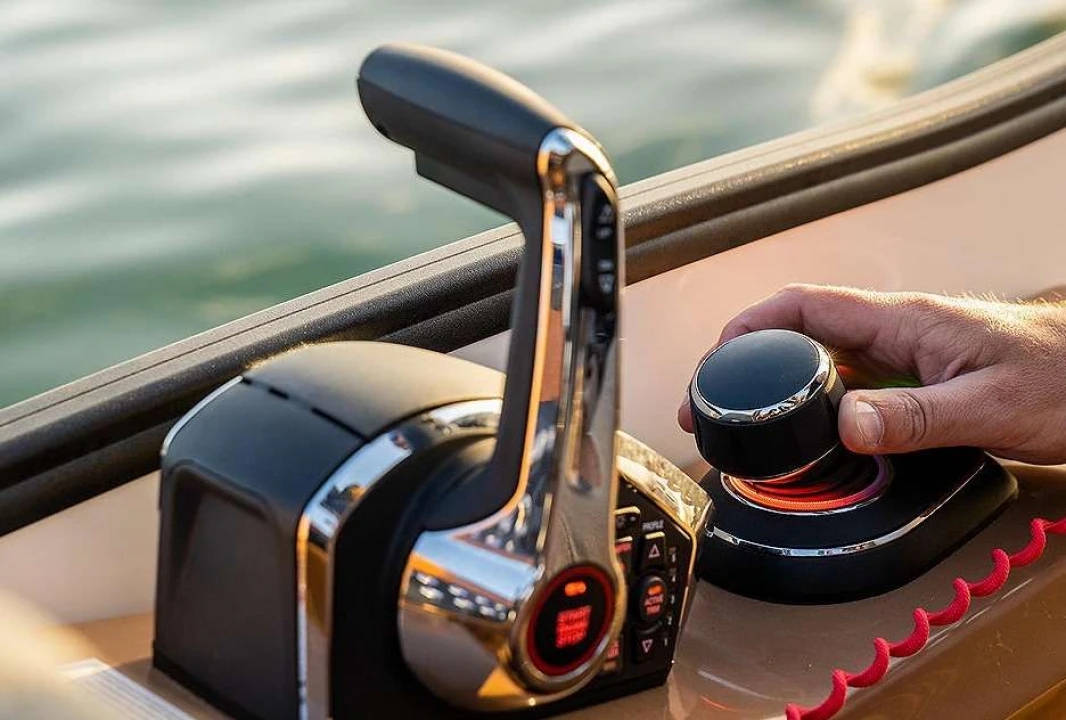
SA – Yes. We have integrated our joystick with Sleipner, Quick and Vetus bow thrusters. Our interfaces allow proportional control of the thruster, coordinating its thrust with that of the outboards. The helmsman can therefore control everything through a single joystick rather than operating the engines and bow thruster separately. This is particularly beneficial on boats where the outboards alone cannot generate the desired movement quickly enough.
PM – Can joystick control also be used on a single-engine boat?
SA – Yes, and two thrusters are not required. A single bow thruster integrated with the outboard steering system is sufficient: the joystick coordinates the two thrust sources and even allows a single-engine boat to move sideways. This is particularly useful in confined spaces.
Fabio Petrone
©PressMare - All rights reserved