

Innovating Yacht Design: Ideas and Perspectives from Antonio Luxardo
When, as a child, you look out of your window and see the sea shimmering, it becomes difficult to separate what strikes your heart every day from what you will eventually become as an adult. Very often, profession intertwines with place of origin, with a passion that takes hold in the soul, and with that “something” special that travels through one’s DNA. This is exactly what happened to Antonio Luxardo. Born in Bonassola, Liguria, he grew up watching boats both offshore and alongside his father, a yacht captain.
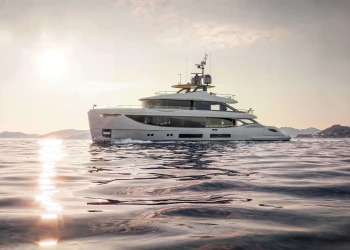
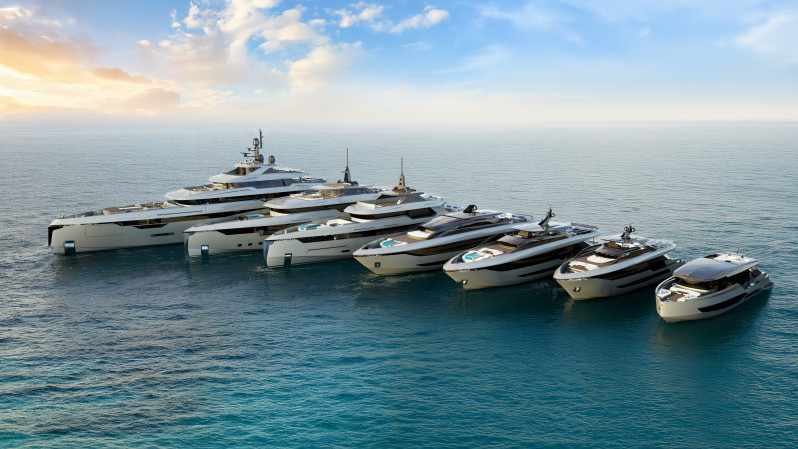
After graduating in Architecture in Genoa and specialising in yacht design, Luxardo began designing for various yards dedicated to wooden boatbuilding as well as in the cruise-ship sector, a field he had explored extensively in his thesis project. With collaborations across major Italian luxury shipyards (Amer, Baglietto, Benetti, CRN, Italian Sea Group, Perini Navi, Sanlorenzo, Baglietto), Antonio Luxardo Design today signs both the new lines of Amer Yachts and the renewed course of Cantieri di Pisa.
PressMare met him, discovering—between one exchange and the next—a particular spark, a drive that continues to burn: the desire to bring something genuinely new to yacht design.
PressMare – Antonio Luxardo, given your background, the answer to “what did you want to be when you grew up?” seems obvious…
Antonio Luxardo – Yes, I had clear ideas from a very young age. In primary school, in a writing assignment, I said I wanted to design boats. I also liked the idea of becoming a captain. It was my father’s job—he captained some of the first megayachts. I spent time with him in ports, boat shows, refit yards. My uncles and grandparents were sailors too. Going to sea is an instinct I carry within me. I started, like many do, with sailing dinghies, on Lasers. Today I’m passionate about the gozzo; I keep mine in Bonassola, where my salty roots are.
PM – But you explored “design” academically at the Faculty of Architecture in Genoa…
AL – Yes, studying Architecture teaches you to have a broader, integrated vision, to develop an eye for observing, identifying key elements, managing and defining spaces. And then the study of Art History, which helps you better understand proportions. I have always been fascinated by analysing the works of artists and architects who introduced true innovation—Leonardo, Michelangelo, Le Corbusier. I also studied urban planning. I believe that having a wide-ranging education allows you to think in an innovative way.
PM – So what does “design” represent for you?
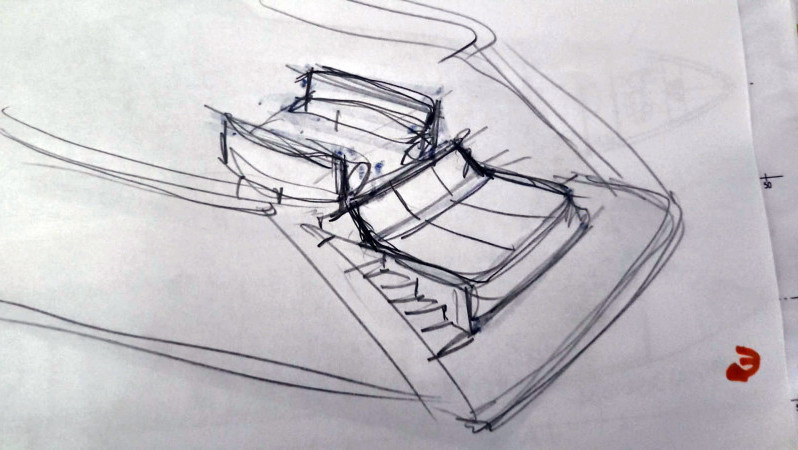
AL – It is a process that begins with an idea that strikes at an unexpected moment—at night, early in the morning, while walking. That spark triggers the excitement of creation. Then comes development, when you gather ideas and refine them: the most stimulating phase. It culminates in the satisfaction of defining the project, with the hope of seeing it built one day. I always start with a hand sketch. I don’t like using computers; that part is handled by my team, who are highly skilled in renderings and 3D modelling.
PM – Where do you begin?
We mainly focus on exterior lines and general arrangements. Interiors are developed only if requested by the client.
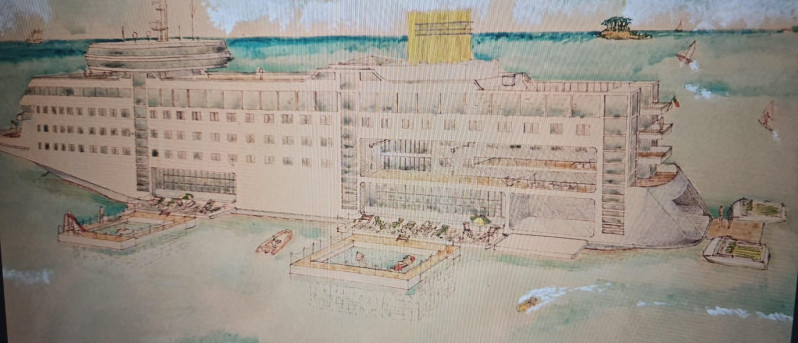
Sometimes you start from a detail and grow the entire yacht from there. Other times it’s the opposite: you begin with the overall concept and then create the detail. But I never disregard function. I always think about what someone would want to do on board, or what they might need to feel well, in harmony with themselves and with the surrounding environment. I felt this strongly back in 1996 during my thesis: I designed a 110-metre cruise ship with glass elevators along the sides, glazed public areas, and shell doors that opened into seawater pools.
PM – What fuels your creativity?
AL – Travel. Seeing different things is a constant stimulus: the more you observe, the more ideas emerge. When you work in yacht design, you risk being trapped in a mindset that always pushes you to think about how a boat is built, instead of how it could be.
PM – And what is your relationship with other design fields?
AL – Certainly car design. It’s a fascinating sector that requires very precise skills. From 2001 to 2019 we worked extensively in China, during a phase of enormous development. Cities were expanding, and we worked across architecture and automotive. Car design helps develop sensitivity to surfaces, their flow, their reflections.
During this “Chinese period” we collaborated with Luigi Colani (the eclectic German designer who passed away in 2019), a strong proponent of organic design. Together we developed a 50-metre catamaran project. It was an invaluable experience, and through him we also met extraordinary figures such as Fabio Buzzi, a master of speed and performance.
PM – You often say “we”…
AL – The team is essential. I believe deeply in that. In my studio, Antonio Luxardo Design, we take care of yacht design. With Optima Engineering, the company I co-founded with Michele Zigniego, we manage engineering. Optima allows us to design any type of vessel and verify whether it is truly buildable; by transferring ideas immediately into an engineering and regulatory framework, the whole process becomes faster.
PM – On what size of yacht do you feel most at ease?
AL – For a long time I worked on small boats, 6–10 metres. Then I moved to 15–24 metres, the size I felt most comfortable with, also because they were the boats closest to my family background. In recent years I’ve shifted to working on yachts from 30 metres upwards, up to 70 and 90 metres.
PM – You are currently designing for Amer Yachts and also creative director of Cantieri di Pisa. How do these roles coexist?
AL – They developed simultaneously. With Amer Yachts we started five years ago, working on steel projects, as I had known Barbara Amerio for a long time—an entirely natural collaboration. At the same time, the new ownership of Cantieri di Pisa was looking to redefine the shipyard’s identity. I took part in a selection involving about fifteen designers, and they chose my proposals because they were more consistent with the brand and the heritage of the Akhir line.
PM – What have you developed specifically for Amer?
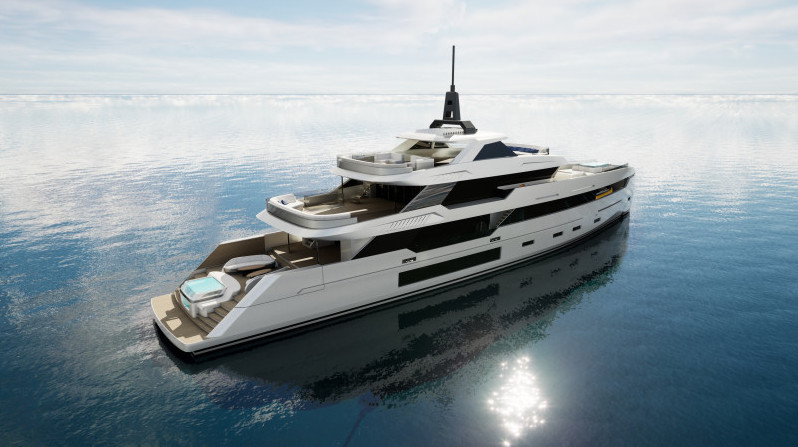
AL – We started with steel. The first Amer currently under construction with my signature is a 74-metre flagship, part of a line ranging from 42 to 58 metres. I also designed the new fiberglass range (96, 106 and 126 feet) and a 146-footer in aluminium.
PM – Many projects… is there a common thread?
AL – First of all, these projects are developed through close collaboration with the Amerio family: we truly work as a team. Founder Fernando Amerio and his children, Barbara and Rodolfo, are deeply involved. I started drafting the concepts, but always through shared reasoning. Their insights, shaped by client feedback and operational experience, are essential.
The fiberglass line includes sporty, high-performance yachts with generous volumes. The 146-footer in aluminium extends the philosophy of the fiberglass range but at a larger scale, offering vast spaces—such as a full-beam salon without side decks—and a refined stylistic language. The steel line is defined by a sharply raked bow and sleek, aggressive lines, paired with a wheelhouse featuring reverse-angled glazing. This detail also appears on the aluminium model but is partially concealed through a subtle design element.

PM – Sustainability is increasingly central in yacht design…
AL – Yes, a green vision is no longer optional. With Amer—especially thanks to Barbara’s strong focus on ecology—we developed an efficient hull and are installing three Volvo Penta engines with IPS drives on the three largest units. But for me, designing with a green approach starts with energy efficiency and energy recovery. For example, waste heat from engines is almost never reused in yachts, while in traditional industry it is standard practice.
It is also crucial to use materials with sustainable supply chains and high-performance insulation, such as reflective glazing. I would very much like to harness energy from the motion of the sea—a sort of onboard dynamo that generates energy from roll, even at anchor. Many of these ideas may seem futuristic today, but they could become viable solutions tomorrow.
PM – What does innovation mean to you?
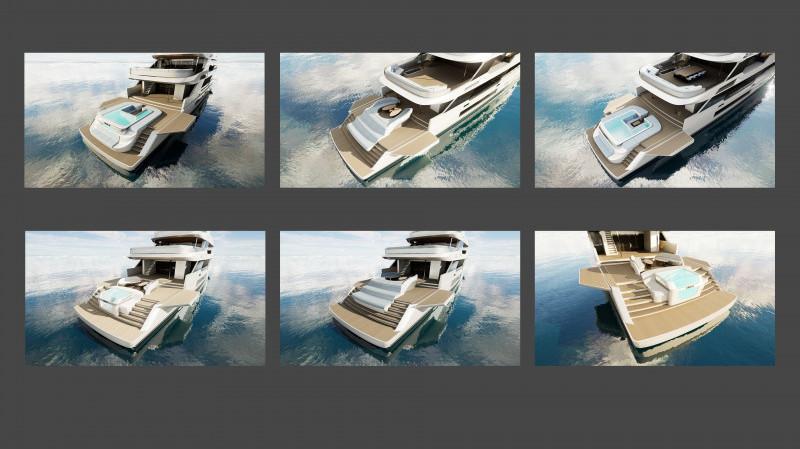
AL – It means bringing something new. I’m working on studies that—hopefully—will make sense in the future to achieve meaningful shifts in yacht design. On larger yachts, for instance, there are still too many vertical routes, too many staircases. I’d like to replace them with horizontal promenades along the vessel.
And I’d like to bring more greenery on board, as was once customary. Historically, the “giardinetto” was the aft-side area of ships where plants and spices were kept. Today, technology helps designers find new solutions aligned with client desires and allows the creation of truly unique yachts. I’m convinced that a visionary client will always exist.
Désirée Sormani
©PressMare - All rights reserved