
Beneteau First 60 makes its Italian debut in Genoa: a new performance cruiser
The new First 60 is the largest yacht Beneteau has ever built in its long-established range of performance cruisers. Making its Italian debut at the 66th Genoa International Boat Show, the 18.95-metre yacht is the result of a collaboration between two Italian designers: Roberto Biscontini, responsible for the naval architecture, and Lorenzo Argento, who designed the exterior and interior. The aim is to combine sailing performance and the pleasure of being at the helm with the space and amenities now expected of a cruiser of this size, appealing to owners who still want to take an active part in sailing their own boat.
For almost 50 years, the First name has been associated with a particular approach to sailing, one in which seaworthiness, helm feel and the ability to fine-tune sail trim remain central. With the First 60, Beneteau brings that philosophy to a size bracket in which both the demands placed on the boat and the way it is used change considerably. Sheet loads increase, onboard systems become more complex, and the ability to handle a yacht of almost 19 metres with a small crew becomes increasingly important, without necessarily having to leave the sailing to professionals. At the same time, the design must deliver a level of comfort appropriate to its size and intended owners.
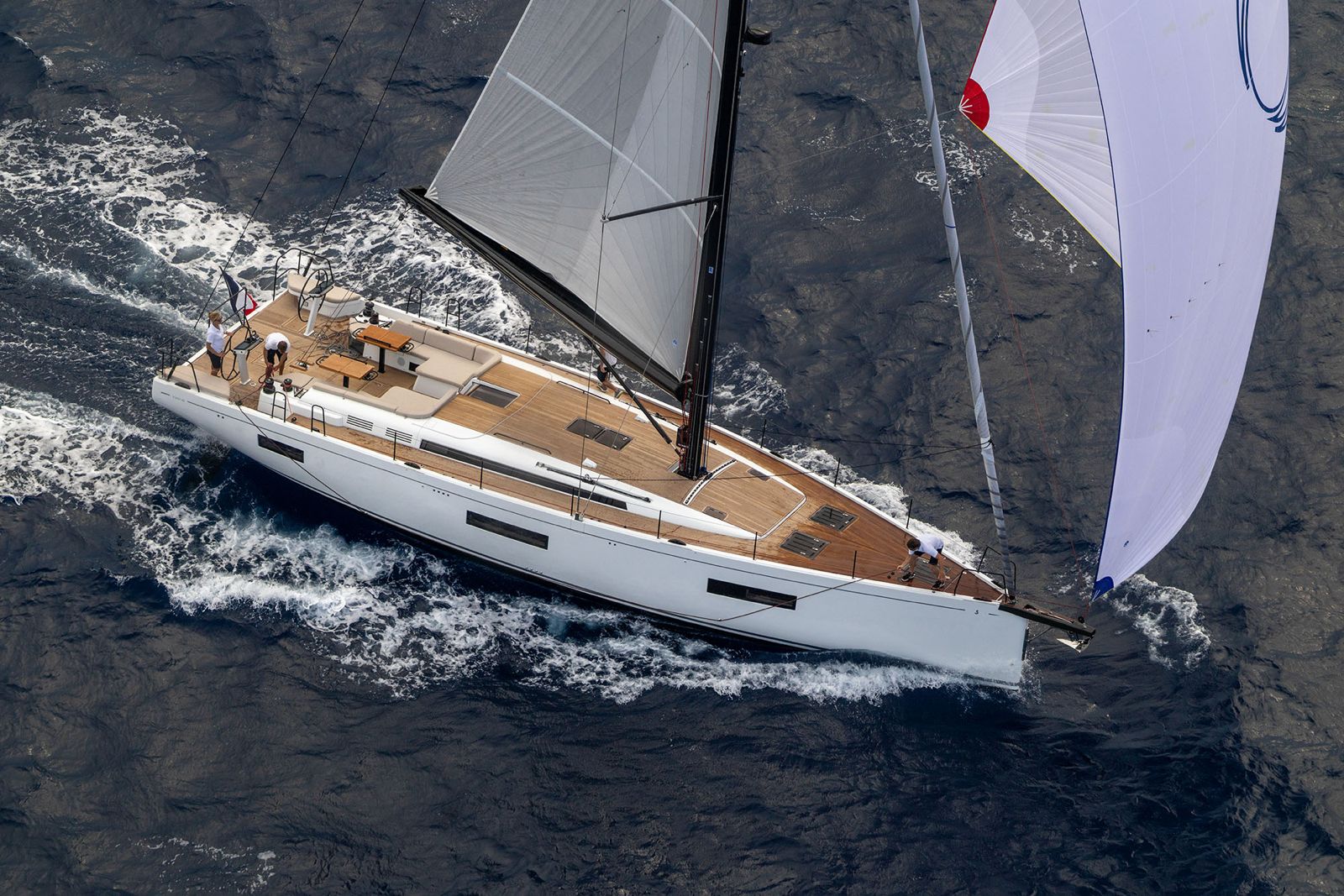
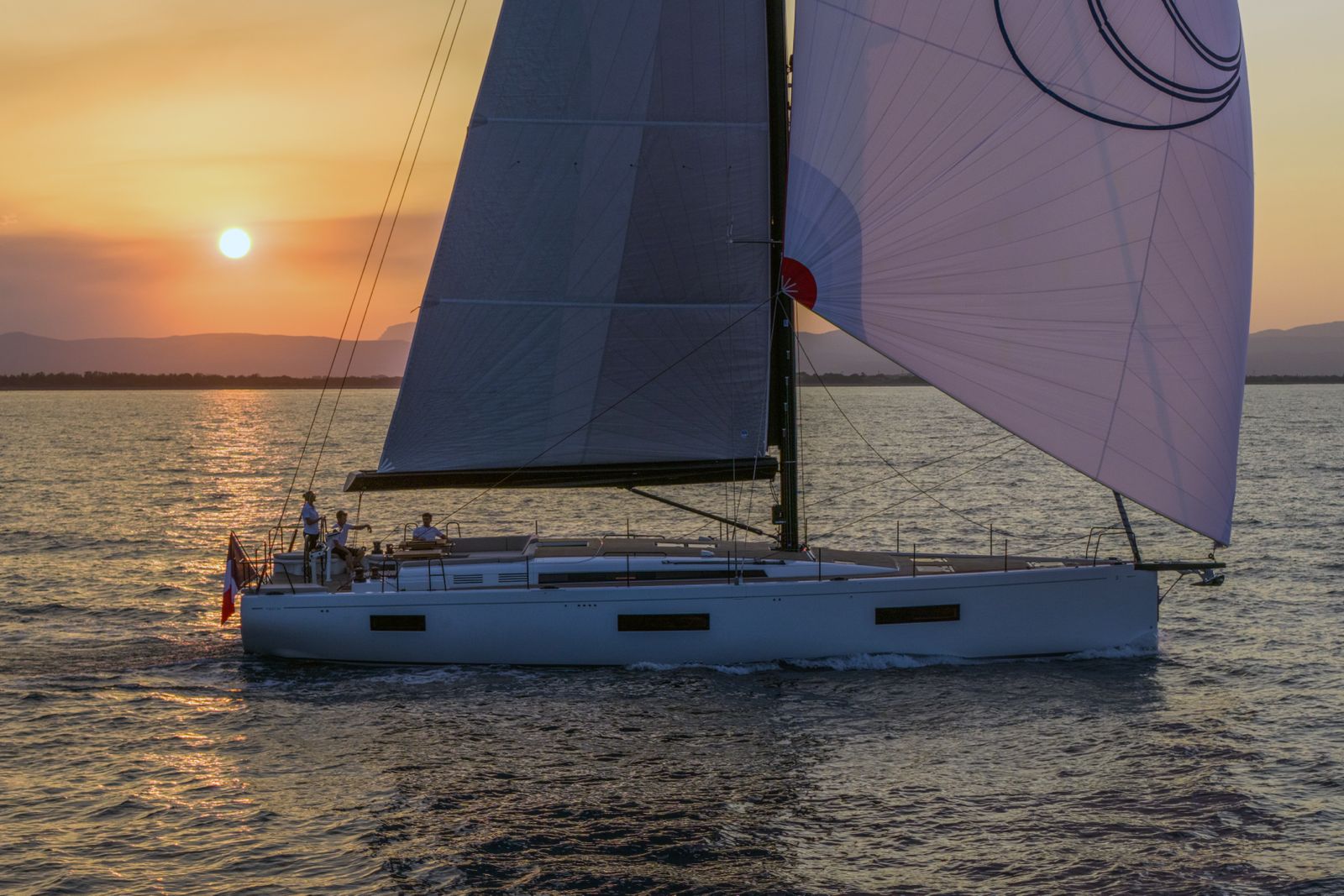
Seen at Genoa, the First 60 demonstrates how closely its styling has been shaped by the practical demands of sailing. Its sleek profile, low coachroof and uncluttered deck reflect Argento's experience and his particular attention to creating a consistent design language between the exterior and the accommodation below.
A deck laid out around sail handling
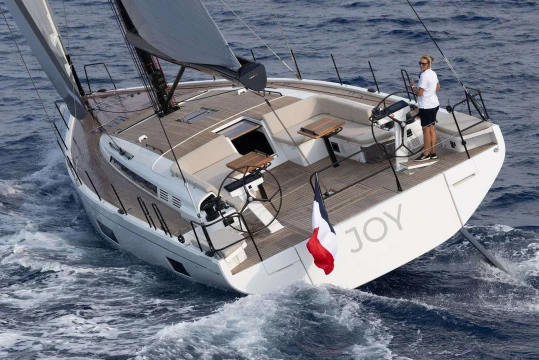
Some of the First 60's most interesting features are found in the cockpit, which is divided into three distinct working and living areas: a zone for steering and sail handling, a dining area and a space for relaxation. This separation is about more than comfort. It reduces interference between those steering and trimming the sails and guests who can continue to enjoy the social areas while underway. It is particularly relevant on a yacht of this size, which may be sailed by its owner or, especially in charter use, operated by a professional crew.
One of the most distinctive features is the arrangement of the winches on the so-called Winch Islands, freestanding stations that allow crew members to move around them when handling running rigging. Unlike a more conventional installation along the coamings or close to the helm stations, this layout provides access to the sheets from different positions, making sail handling easier whether there is a full crew aboard or only a few people. The unobstructed working space around the winches also makes it easier for the helmsman to take part in sail trim, an advantage for owners who enjoy sailing the yacht themselves.
Considerable attention has also been paid to mainsail handling. The mainsheet is controlled by a Harken captive winch installed beneath the cockpit sole, an arrangement capable of dealing with substantial loads while keeping much of the rope that would otherwise have to be coiled and stowed out of sight. The system is complemented by a semi-Park Avenue boom, whose broad section helps contain the mainsail as it is lowered. Together, these details make operations more manageable on a yacht with a sail area of this magnitude, where suitable hardware and a carefully thought-out running-rigging layout are essential.
A seemingly minor detail at the helm neatly illustrates the thinking behind the design. During our visit aboard at the Genoa Boat Show, Lorenzo Argento drew our attention to the helm seats built into the side decks, which can be tilted to compensate for heel. Simple in principle but cleverly executed, the arrangement enables the helmsman to sit comfortably and naturally on the windward side even when the yacht is heeled over. It is the kind of detail likely to be appreciated all the more on longer passages, demonstrating that the helm ergonomics have been designed not simply to make sailing easier, but to make time at the wheel more enjoyable.
Naval architecture and sail plan
With a length overall of 18.95 metres, a maximum beam of 5.30 metres and a stated displacement of 22,280 kilograms, the First 60 occupies a sector in which performance must inevitably be balanced against the weight of the equipment and fit-out needed for cruising. The hull has broad aft sections and twin rudders, a well-established configuration intended to maintain control across a range of points of sail, including at substantial angles of heel. Two keel configurations are offered, with different draughts to allow owners to place greater emphasis either on access to harbours and anchorages or on sailing performance.
There are also two rig options: a standard aluminium mast or a carbon-fibre mast built by Axxon, approximately 1.10 metres taller and, according to the yard, around 100 kilograms lighter. The mainsail area consequently increases from 105 square metres on the standard version to 112 square metres on the more performance-oriented configuration, while the 111% furling genoa measures 84 square metres. This offers owners a meaningful choice based on their sailing programme without altering the yacht's overall concept. The carbon rig combined with the deeper-draught keel is aimed at those seeking greater performance, while the standard configuration is more cruising-oriented without abandoning the First's sporting character.
Below decks: three cabins and a cruising-oriented layout
Lorenzo Argento's interior design carries forward the First range's visual language on a scale where living accommodation inevitably assumes greater importance. Pale surfaces, timber finishes and restrained contrasts create a contemporary atmosphere, with natural light entering through the coachroof glazing and hull windows. The layout provides three cabins and three heads, with the owner's suite forward of the mast and the two guest cabins aft.
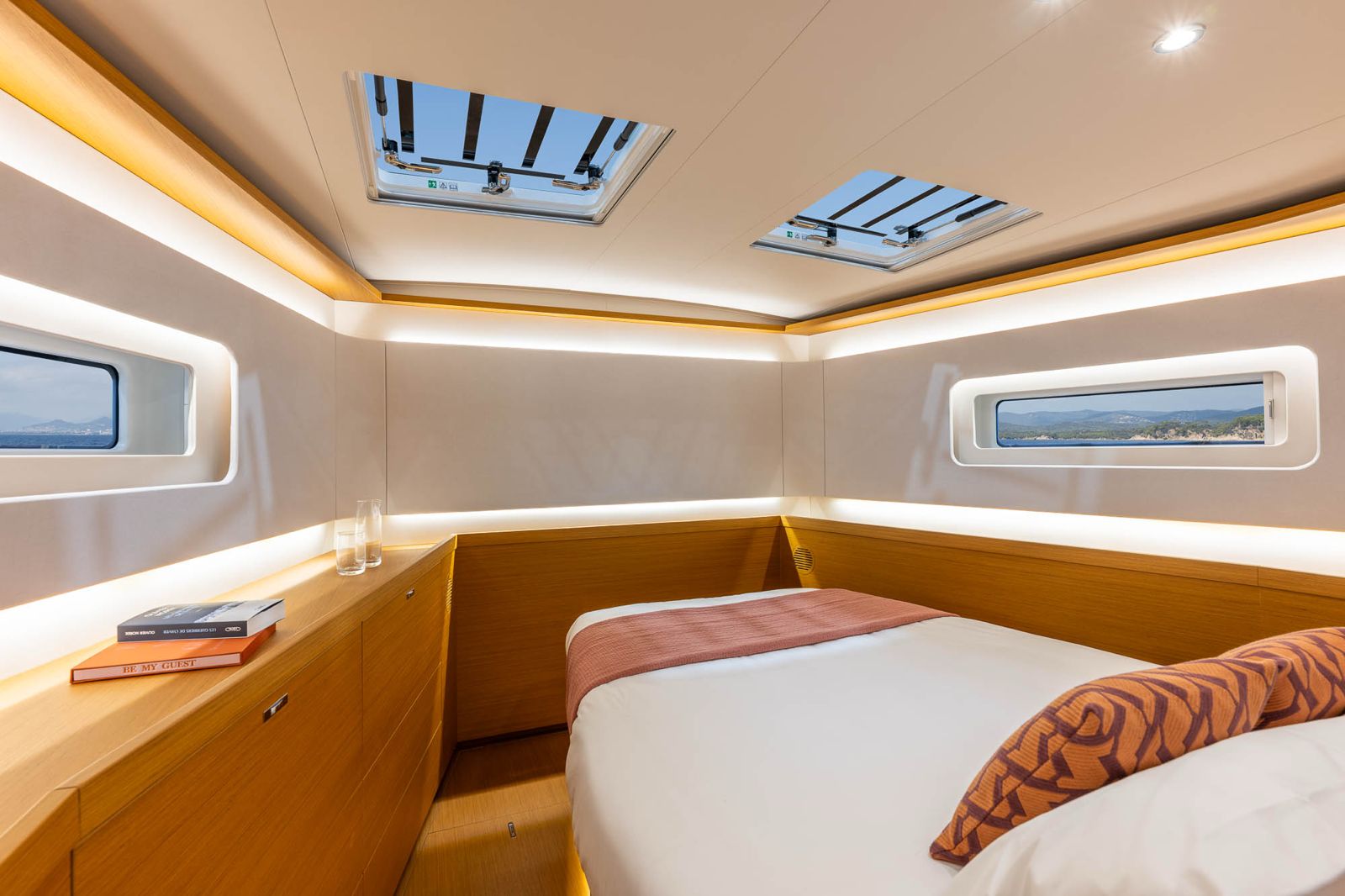
The owner's cabin is one of the most interesting spaces on board, particularly for the arrangement of its queen-size bed. As on many contemporary maxi yachts, it is aligned fore and aft, with the headboard facing aft and the foot of the bed towards the bow. Easily accessible from both sides, this arrangement allows greater freedom of movement around the bed and adds to the sense of space. Hull windows and deck hatches admit plenty of daylight, while wardrobes and additional stowage make the cabin suitable for extended cruising.
Amidships, the saloon has a generous dining area to port and, opposite, a sofa alongside a proper chart table with its own navigator's seat. This is a noteworthy feature on a modern yacht, where navigation is increasingly managed through the electronic displays at the helm stations. Retaining a dedicated chart table, also useful for monitoring onboard systems and organising life at sea, reflects an approach to cruising in which passage planing still has an important place below decks.
The galley, positioned forward of the saloon, is arranged athwartships and extends across the available beam, with work areas on both sides to keep different tasks separate. There is ample worktop space and plenty of stowage, while refrigerators, a wine cooler, a freezer and cooking equipment cater for longer periods on board.
The largest First, with a clear identity
With this new model, Beneteau extends a range that encompasses very different sizes and ways of sailing. While the smaller First models favour a distinctly sporting approach, the larger yachts, including the 44, 53 and now the 60, place greater emphasis on balancing performance, comfort, and joy of sailing. Our visit aboard at the Genoa Boat Show highlighted both the coherence of the deck layout and a number of ergonomic details that show genuine consideration for the people sailing the boat. The First 60 makes no attempt to disguise its cruising ambitions, but interprets them through a design that continues to give a central role to the pleasure of taking the helm and trimming the sails oneself. Naturally, only a sea trial will allow a proper assessment of helm response, hull balance and performance across different wind conditions: essential considerations when evaluating a yacht carrying a name with as much heritage as First.
To provide owners with continued support after delivery, Beneteau has also introduced a personalised assistance programme through its Premium Service, complemented by initiatives dedicated to the First 60 owners’ community. This approach reflects the expectations of owners who value an ongoing relationship with the shipyard, extending to the management.
Giuliano Luzzatto
©PressMare - All rights reserved