Q-Line, a new idea of luxury at sea
Q-Line, a new idea of luxury at sea


“It represents a new interpretation of luxury in large yachts. The Q-Line offers space and freedom without relying on extreme length, draught or high energy consumption. Antonio Luxardo has created something truly special. There is a very Italian sensuality in the design: elegant proportions, soft curves and a certain seductiveness. But behind this beauty lies a great deal of innovation. It is a luxurious and emotional project, yet at the same time fresh, intelligent and unmistakably new.”

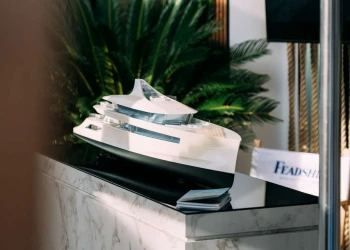
This is how Olaf Steckstor, Director Sales & Development at Ultimate Catamarans, describes the brand-new catamaran line presented at the Monaco Yacht Show. Ultimate Catamarans is not a shipyard, but the company responsible for developing the project and coordinating the different areas of expertise, bringing designers, engineers, systems specialists and builders together as one team. It is an organisational model built around quality, bringing together high-level specialist expertise and integrating it from the earliest stages of the project, from design and engineering to technology, safety and comfort. The same focus on quality guides the choice of production partner: construction is entrusted to ISKRA Shipyard in Šibenik, Croatia, selected by Ultimate Catamarans for its quality standards and expertise in aluminium construction. ISKRA designs and builds new vessels and yachts up to 60 metres in length, including aluminium catamarans and passenger ferries.
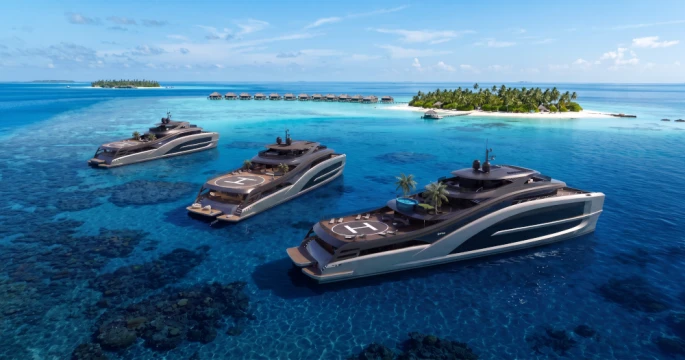
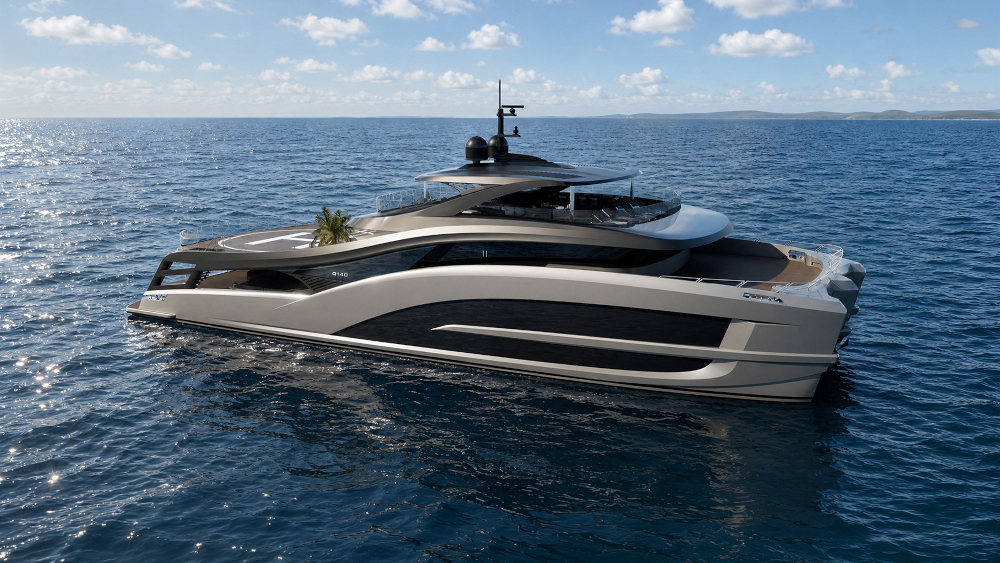
The Q140 is the first project and stems from a change in perspective: not how large a superyacht should be in terms of length, but how best to use the surface area available. This 42-metre yacht is the first model in the Q-Line, a new family of catamarans comprising the 32-metre Q110, the Q140, the 52-metre Q170 and the 62-metre Q200. The range interprets naval architecture through a design language closer to the world of contemporary design than to the traditional vocabulary of catamarans.
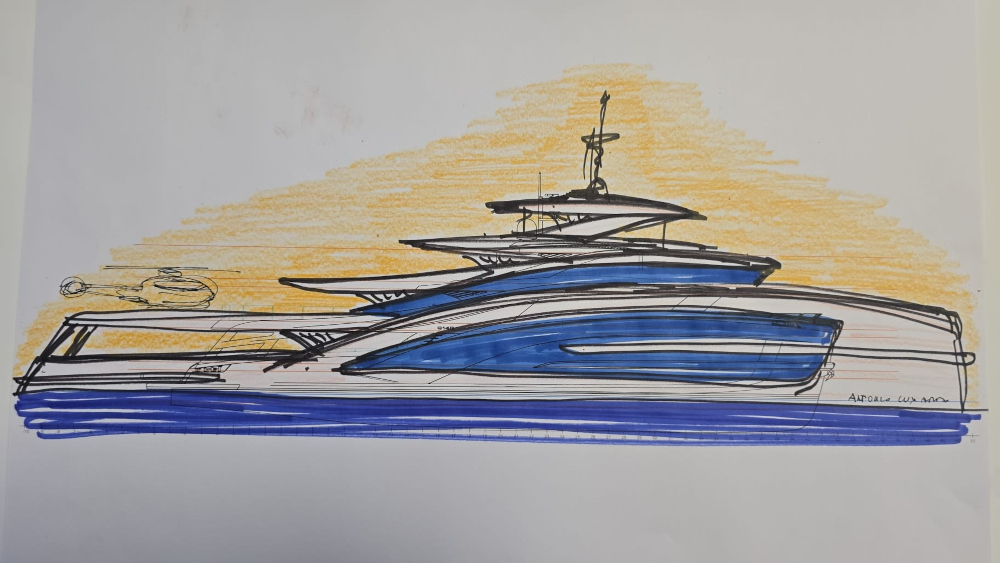
Its identity has been defined by Antonio Luxardo, the Italian yacht designer responsible for the entire line. “The project was born almost as a graphic gesture: an initial sketch drawn quickly, without a lengthy phase of formal research, when Ultimate Catamarans asked me to imagine a possible direction,” the designer explains. From that drawing emerged the idea of moving beyond the conventional aesthetics of large catamarans, often characterised by rectilinear volumes and visually heavy superstructures.
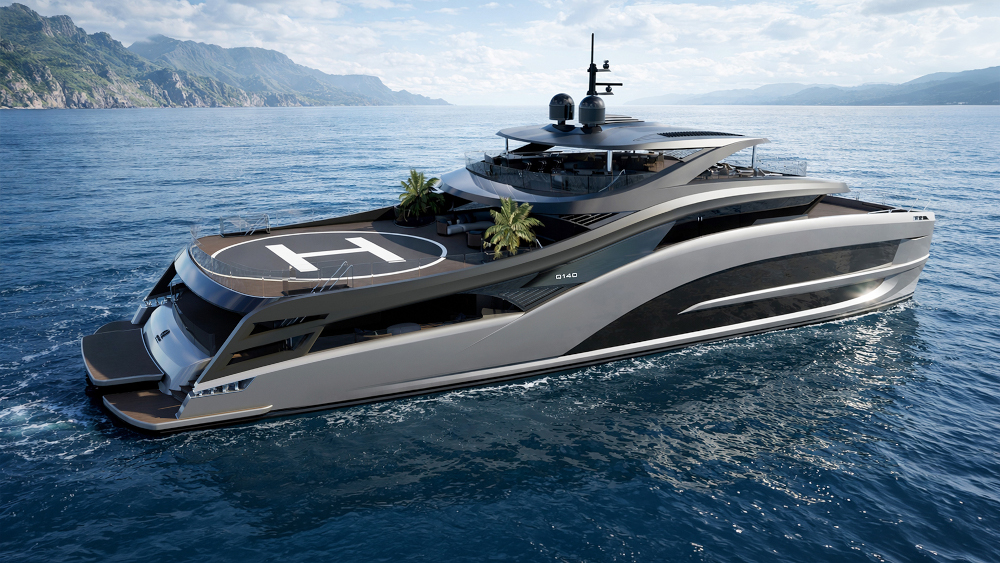
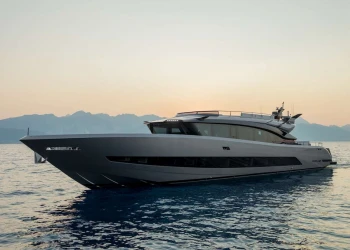
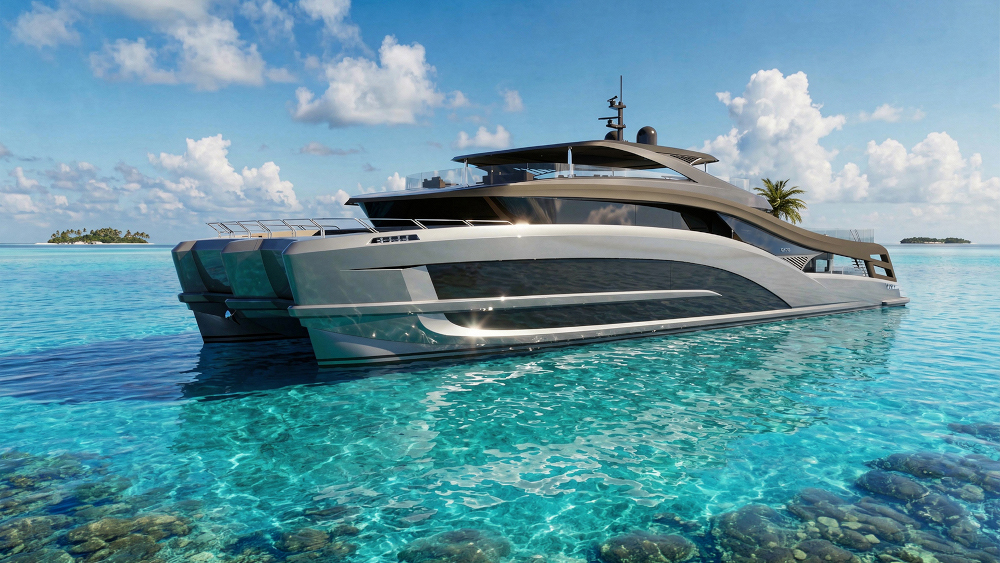
Luxardo instead chooses curves. Not as a simple stylistic exercise, but as a tool to adjust proportions and visually lighten a platform that is necessarily very wide. The surfaces descend from bow to stern and narrow as they rise, creating a more streamlined silhouette. It is particularly from three-quarter views that the originality of the project becomes apparent: rather than becoming a perceptual limitation, the catamaran’s beam is transformed into an architectural quality.
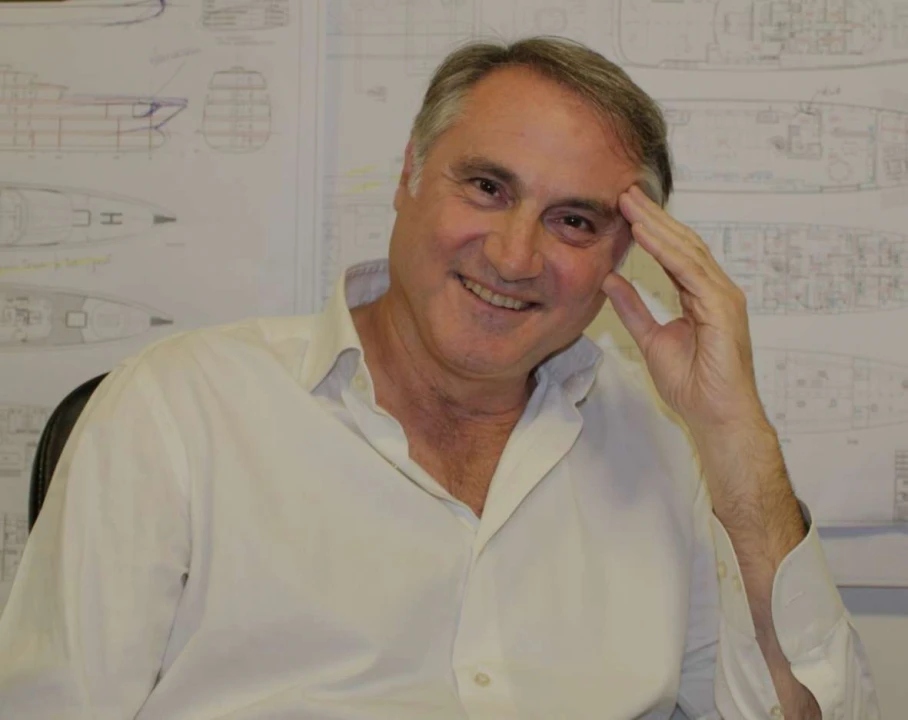
“The high bow is one of the most recognisable features,” the designer explains. “It originates from a specific naval requirement – to provide greater protection when sea conditions become challenging – but it also becomes the starting point of the exterior line. From there, the surface guides the eye towards the stern, interrupted by a horizontal element running across the large lateral glazed section.” The extensive, continuous glazing is not merely a solution to broaden the view: it becomes a design material in its own right, a surface that dissolves the boundary between interior and landscape. The exterior colour scheme can also be specified in different finishes, allowing for a high degree of customisation.
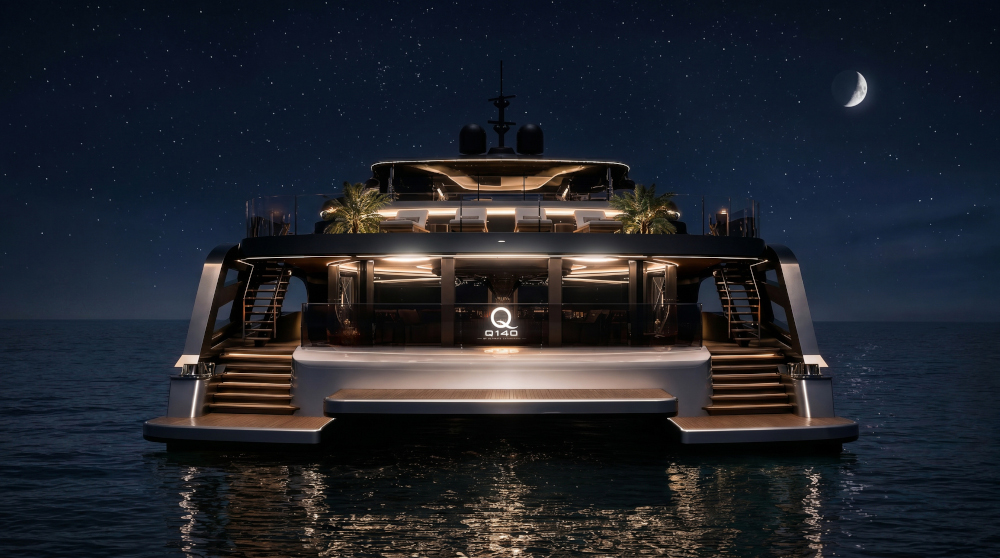
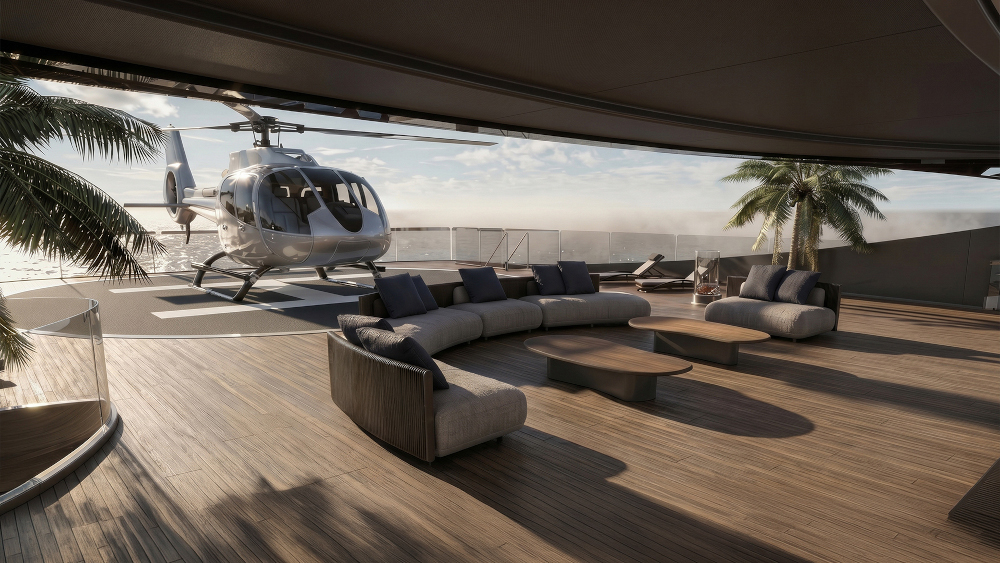
This relationship with the exterior is one of the most interesting aspects of Luxardo’s work. The platform’s considerable beam makes it possible to conceive the interiors not simply as rooms overlooking the sea, but as spaces immersed in the surrounding landscape. “On the Q140, 457 square metres are dedicated to guest interiors and 464 square metres to exterior spaces: an amount comparable to many 60-65-metre monohull superyachts, but concentrated within a length of just 42 metres,” Luxardo points out.
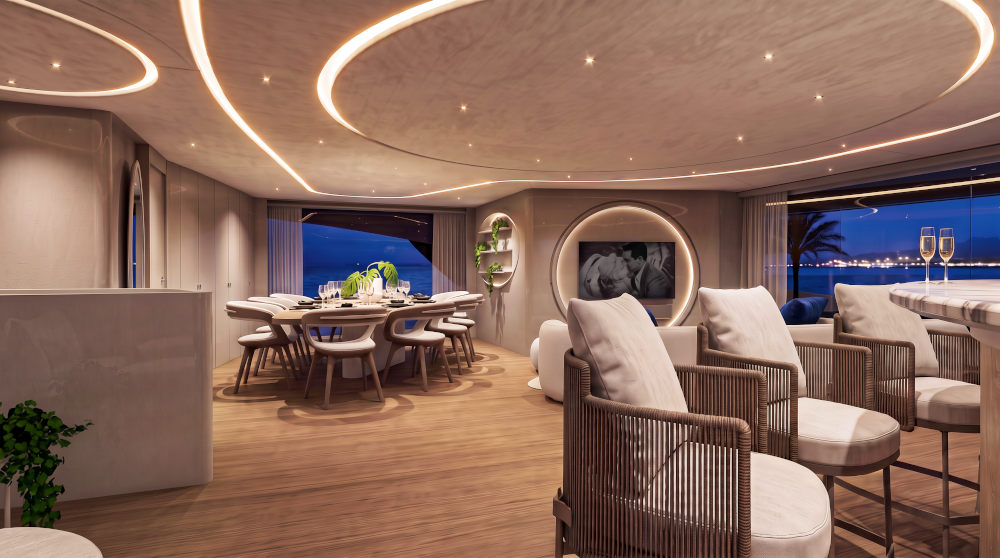
The result is a different idea of luxury, defined not by an abundance of materials but by freedom. Generous suites, interior headroom of at least 2.20 metres, large social areas and a clear separation between owner, guest and crew spaces. The layout and interior design can also be developed according to each owner’s requirements, taking advantage of a main deck whose dimensions are exceptional in relation to the yacht’s overall length.
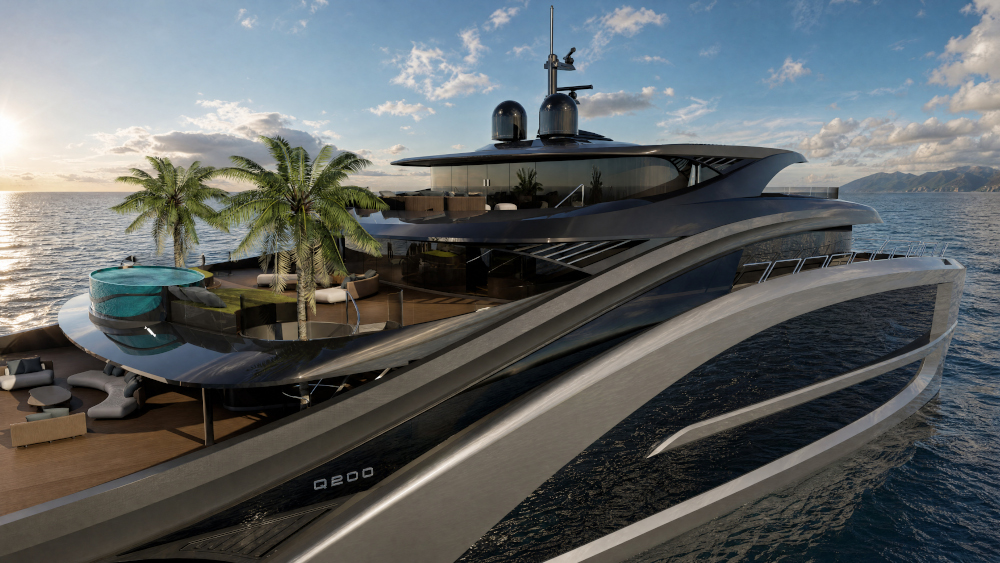
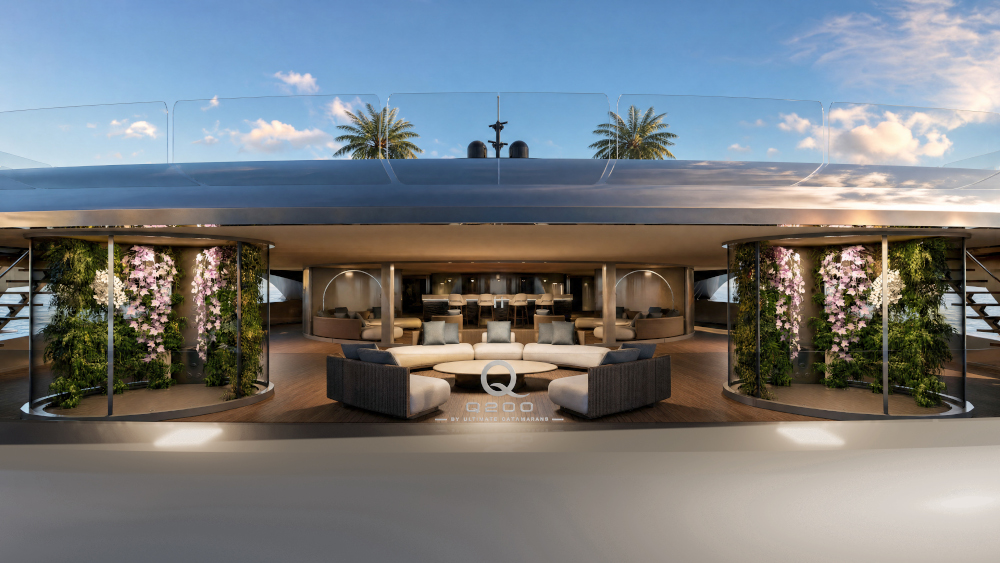
This abundance of space also shapes the language of the interiors. Luxardo introduces circular and oval geometries, deliberately avoiding the rigidity of right angles. On the Q200, the largest model in the series, the design goes as far as integrating nature into the architecture: open staircases interwoven with greenery and large cylindrical glass showers surrounded by plants transform some areas into small domestic landscapes. Even the sunbathing areas move away from conventional sunpads, incorporating grass and palm trees to evoke the feeling of being on an island. It is a biophilic approach that brings an almost landscape-like dimension on board.
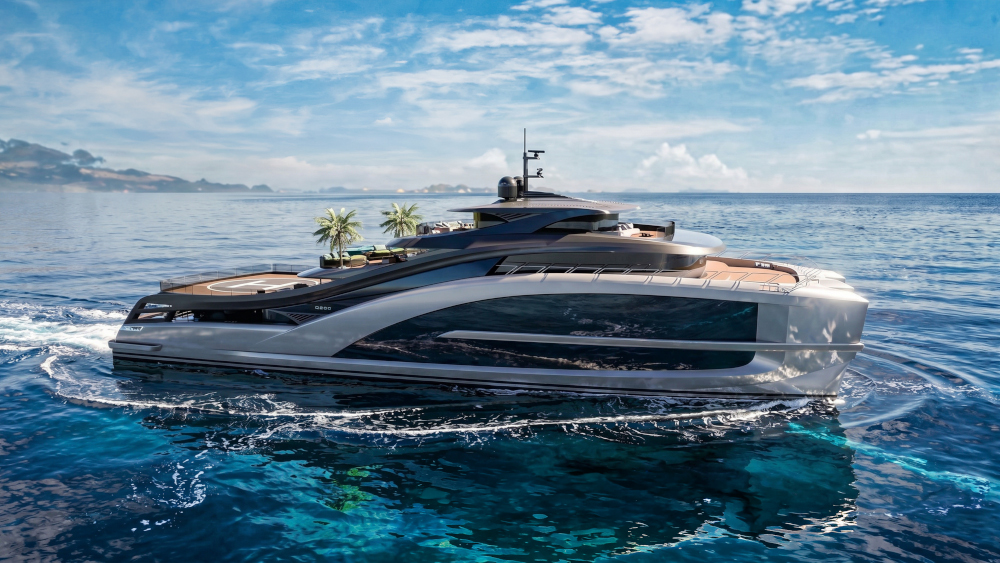
Visual lightness, however, must not translate into structural fragility. The high bow, aluminium construction and closely spaced structural frames are conceived for genuine ocean-going use. The limited draught also contributes to a different relationship with the coastline, allowing the yacht, where conditions and regulations permit, to access shallower anchorages. The research is not limited to design but extends to efficiency. According to data supplied by Ultimate Catamarans, at around 12 knots the Q140 can require up to 70% less propulsion energy than a monohull comparable in terms of usable space and operating profile. This is also an interesting principle from a design perspective: efficiency is not added to the project, but derives from its architecture itself.
The Advanced Hybrid Propulsion system, fitted as standard, combines diesel-electric generation, batteries and intelligent energy management. At anchor, when conditions permit, the generators can be switched off and the yacht can operate on battery power. The most immediate result is not simply lower energy consumption, but a different sensory experience: less noise, fewer vibrations and no exhaust smell. The optional TRI-HYBRID™ system takes this approach a step further through the integration of fuel-cell technology.
The Q140 thus becomes an exercise in balancing opposites: large yet compact, sculptural yet functional, technological yet natural. It is a project in which form does not conceal technology, but instead emerges from the need to interpret it in a new way. Perhaps the real innovation of the Q-Line lies precisely here: in transforming the catamaran’s exceptional beam from a simple dimensional parameter into a new material for design.
“With the Q-Line, we are not simply presenting another large catamaran. We are proposing a different way of conceiving luxury at sea,” says Olaf Steckstor. “More genuinely usable space, greater privacy, increased freedom in configuring the interiors and significantly lower energy demand can coexist with a highly emotional and sophisticated design. I believe it is this combination that owners will appreciate most when they have the opportunity to discover the Q-Line in detail.”
Désirée Sormani
©PressMare - All rights reserved