Electrification, low-carbon materials, new applications: Groupe Beneteau continues its CSR trajectory


The Group has reduced its CO₂ emissions intensity by 26% compared to 2022 and is implementing concrete industrial measures in response to the transformations taking place in the boating industry.
How can we electrify boats, develop complex composites that can be recycled, extend the lifespan of vessels, and make boating accessible to a wider audience?
With the release of its 2025 Annual Report, Groupe Beneteau presents the industrial and collective solutions it has implemented to address these challenges. Since 2022, the Group has reduced its CO₂ emissions intensity by 26% across all scopes and is pursuing its goal of a 30% reduction by 2030.
« We are making progress in the areas of propulsion systems, materials, the lifecycle of vessels, and services, all with a single goal: to turn our commitments into concrete, implementable solutions. In these areas, we are choosing to take action, experiment, and collaborate with our partners to drive the industry forward. » Bruno Thivoyon, Chairman of Groupe Beneteau’s Management Board.
Electrification: Structuring a response across the whole sector
In 2025, Groupe Beneteau offered 13 models equipped with alternative propulsion systems, compared to 10 in 2024.
This momentum continues with the creation of E-LEKTRA MARINE, a 50-50 joint venture with the Groupe Fountaine Pajot. Bringing together seven brands representing nearly 60% of the global sailing market, it aims to develop an open standard for electric propulsion and smart onboard energy management.
By pooling their production volumes and expertise, the two groups intend to accelerate the industrialization, deployment, and maintenance of these solutions, with one goal: to achieve 10 to 15% adoption of electric propulsion in the global sailing market by 2030 —representing several hundred boats per year.
Materials: Substituting resources and organizing recycling
The nautical building traditionally uses composites that combine fossil-based polyester resins and virgin glass fibers. While these materials are strong, they remain difficult to separate and recycle.
The Group is taking action on both the composition of its products and their end-of-life management. In 2025, its facilities produced 4,400 parts made of hemp fibers, using 5,500 kg of fibers sourced from a supply chain in the Vendée region. Combined with a resin containing 35% bio-based materials, this solution reduces greenhouse gas emissions from the parts in question by 24% and their consumption of fossil resources by 35%, resulting in 11 metric tons of CO₂ avoided.
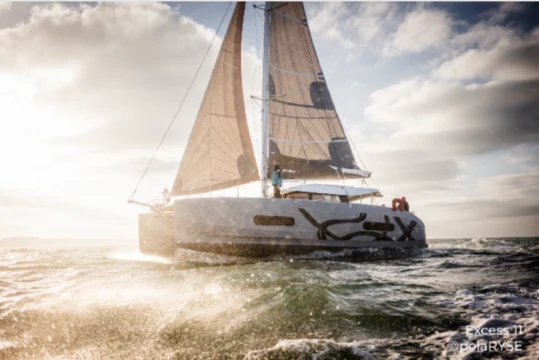
The Group is continuing to roll out Elium® recyclable resin, having already used 12.6 metric tons of the resin and 14 metric tons of recycled or natural fibers. In April 2026, the EXCESS brand unveiled the Excess 11, the world’s first multihull built with Elium® recyclable resin, marking the transition from experimentation to application in a production boat.
Together with Arkema (resin), Composite Recycling (sorting), Owens Corning (fiber), Chomarat (weaving), and Veolia (logistics), the Group has formed a unique industrial alliance bringing together all the key players in the industry. Its goal is to create a complete closed-loop system, from the collection of production scraps to the reuse of resins and fibers in new boats, and eventually in end-of-life vessels.
Life cycle and accessibility: Developing new models of use
The transition does not rely solely on new boats. The Group’s refit program aims to refurbish 30 to 40 vessels per year. The acquisition of BMS Shipyard (Canet-en-Roussillon, France) strengthens this expertise.
True to its mission, “Bringing dreams to water”, the Group is also expanding shared use and services. In 2025, 1,010 subscribers had access to 110 self-service boats—roughly one boat for every nine users. Nearly 15,000 boats were equipped with Seanapps, a 50% increase year-over-year.
These solutions are all part of the same trend: making boating more accessible and supporting boaters throughout the life of their boat.
Skills: Preserving and passing on know-how
New materials, electrification, and evolving processes are transforming the boating industry. In a cyclical market, the challenge is also to retain skills during periods of lower activity. In 2025, more than 92,000 hours of training were provided to the Group’s 6,200 employees. The mentorship program involved 715 mentor-mentee pairs across 43 industrial trades, representing 32,400 hours of on-the-job training.
The workplace accident rate was also reduced from 15 to 12.3, while women now make up 32.5% of the workforce, with a target of 40% by 2030.