
EU-US tariffs and yachting: agreement moves closer, but uncertainties remain over steel, aluminium and trade stability
On May 20, 2026, the European Parliament and the EU Council reached a political agreement on the regulations intended to implement the tariff commitments provided for in the joint declaration signed between the European Union and the United States in August 2025. What may appear to be a technical step could nevertheless have significant implications for the European and Italian yachting industry. The agreement represents one of the most concrete attempts in recent years to restore order to transatlantic trade relations, worn down by a long period of tariff tensions and regulatory instability. The legislative proposals, presented by the European Commission on August 28, 2025, must now be formally approved by Parliament and the Council before entering into force.
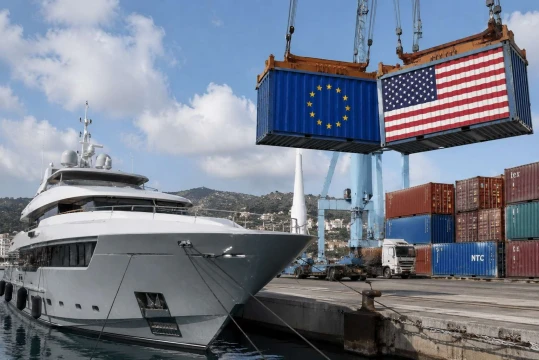
For the yachting sector, the core of the agreement lies in the reduction to zero percent of European duties on industrial goods imported from the United States — including recreational boats — and in ensuring more stable access to the American market for European exporters, within the 15% tariff threshold agreed between Brussels and Washington. For a strongly export-driven sector such as yachting, and especially for Italy, the stakes are considerable: the United States remains one of the world’s key markets both for large yachts and premium marine components.
Yet behind this apparent normalization, caution remains high. This is evident in the very architecture of the agreement, built around safeguard clauses, suspension mechanisms and monitoring tools allowing the EU to react quickly to any change of direction from Washington. The European zero-duty regime will automatically expire on December 31, 2029 unless explicitly renewed — the so-called “sunset clause” — and before any extension the Commission will have to assess the impact of the measures on industry, SMEs and trade balances with third countries. For a supply chain operating on multi-year industrial programs, often with production horizons exceeding three or four years, the lack of a stable long-term perspective remains a structural issue.
The most critical issue, however, concerns steel and aluminium. In 2025, the United States expanded by more than four hundred categories the list of derivatives subject to additional duties, including numerous components used in the marine industry. This is where the matter becomes strategically important for Italian industry, whose competitive strength lies not only in shipyards and large yachts, but also in a widespread and highly specialized supply chain — accessories, custom structures, technical furnishings, deck systems, steel and aluminium manufacturing — supporting fleets and shipyards worldwide, including in the United States. Not surprisingly, the new European text includes the possibility of suspending tariff preferences as early as December 31, 2026 if Washington continues applying duties above 15% on European derivatives of these materials. Brussels’ political message is clear: the objective is to avoid a new escalation, while simultaneously equipping itself with all the necessary tools to react. The result, for European yachting, remains an ambivalent condition: a less conflictual trade framework compared to recent years, but with tariff risks that cannot yet be considered fully overcome.
This is probably the real core of the issue. The competitiveness of the yachting industry no longer depends solely on the ability to build better or more innovative yachts, but increasingly on the stability of international scenarios, access to raw materials, supply chain resilience and geopolitical relations between major economic areas. In this respect, the EU-US agreement represents a step forward. But it still resembles more a monitored trade truce than a definitive solution.
©PressMare - All rights reserved