The Ocean Race Atlantic: Leading Trio Pulls Ahead


It has been another physically and mentally testing 24 hours out on the North Atlantic for the six crews racing from New York to Lorient, France in the inaugural edition of The Ocean Race Atlantic.
You can watch all of the action on The Ocean Race YouTube Channel.
With the fleet now spread over 430 miles east to west, the teams have been experiencing a wide range of weather conditions on their fifth day of racing along the 3,000-nautical-mile transatlantic racecourse.
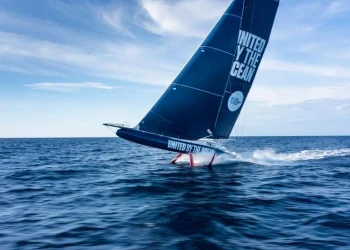
The leading group of three – Francesca Clapcich on the 11th Hour Racing boat (USA), Paul Meilhat’s United by the Ocean (FRA), and Kojiro Shiraishi’s DMG MORI Global One (JPN) – have somehow managed to pull ahead of the low pressure system that pummelled them yesterday with winds gusting over 30 knots and an unpleasant sea state that made eating and sleeping close to impossible.
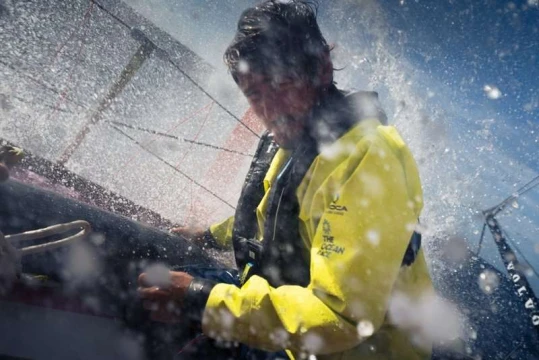
“I don’t remember so many days like this on an IMOCA,” said Clapcich. “It was not really about the wind. We had strong wind but it was really the sea state that was terrible. The wave angle - sort of a wide upwind / close reach - was so painful.
“I think it takes more mental energy than physical. We had such strong winds and big seas that we had to reduce some sail, but after that the boat was just going on its own. Mentally it’s really hard. You cannot move on board, it’s hard to eat, it’s hard to drink. It’s nice to have other people on board - you are sharing the pain.”
At 1200 UTC / 1400 CEST today – and as the leading group reached the halfway point in the race in terms of mileage – Team Francesca Clapcich powered by 11th Hour Racing continued to lead the fleet with a 22-nm advantage over United by the Ocean in second, and the DMG MORI Global One boat in third, a further 14 nm behind.
“We are exactly in the middle of the Atlantic, with the same distance to Lorient and from New York,” noted United by the Ocean co-skipper Paul Meilhat. “So it's 1500 miles to go. It should be much easier than the start. with maybe more flat water. and higher average speed, so it's probably going to be fast."
“We are just behind 11th Hour Racing and we have DMG MORI (Global One) a few miles back. And maybe Boris will join us because we are almost certainly stopping with no wind tonight, so maybe we can reduce the gap. It means the race will be really open… It’s possible we all arrive in Lorient together!!”
Aboard the third-placed Japanese boat, DMG MORI Global One, Nicolas Lunven described what life had been like on board while in the heart of the depression.
“We are reaching at 80–90 true wind angle in 30–35 knots of wind,” he said. “It’s quite uncomfortable and very noisy. We have to find the right balance between the performance, the comfort on board, and to not break anything. Sometimes we ease the sheets to make sure the boat is not going at 35 knots and doesn’t do a big nosedive.”
Although now out of the worst of the weather, the frontrunning trio are still hammering their way across the Atlantic at boat speeds in the mid-to-high twenties as they try to make the most of 20 to 25-knot southerly winds and keep the speed up for as long as possible.
Meanwhile, Boris Herrmann’s Team Malizia sat in fourth place, 115 nm off the lead and still in the grip of the low pressure system, with the crew experiencing winds above 25 knots and fighting through a relentless slamming sea state. The goal is to reconnect with the leading group following Saturday’s slow down to repair the foil ram and controls.
It has been a difficult 24 hours of racing for the crew of Oliver Heer’s fourth-placed Embrace the Challenge (SUI), who reported significant damage to their mainsail, sustained as the crew attempted to put in a reef yesterday evening in very strong winds.
Unable to safely attempt repairs in the dark, the team decided to drop the sail completely and wait until first light this morning to make a full assessment of the damage and formulate a repair plan.
Heer sent this message explaining what had happened:
“Well, this is not the Sunday morning we wanted, but here we are,” he said. “Last night, just before sunset, we wanted to put the third reef in, and the leech line ripped on our mainsail. It’s about a two-metre tear inside the leech tape. Conditions were too bad to attempt a repair, but now here we are at first light and Liz [Wardley] is already sitting inside our mainsail and starting our repair. We are confident. We hope that if we give it our best we will be back out racing and sailing to the finish line in Lorient by tonight.”
According to Wardley, known as one of the best at managing onboard fixes, her plan is to first stitch the leech line back onto the sail and then reinforce it with strong adhesive-backed sail cloth.
“Luckily we have got some nice breeze to dry the sail off,” she explained. “We will prep it with a bit of acetone – we are going to Sikaflex them (the patches) down as well. We have got one hit at this as we only have enough material for one go at it. So we will make sure it’s nice and clean, make sure it adheres properly, and then we will sew it again. I’m going to be in this boom bag all day, I reckon.”
The crew of Conrad Colman’s sixth-placed MSIG Europe (NZL) have been suffering too, albeit in very different conditions as they attempt to make progress downwind in the wake of the Atlantic storm. In the light winds, a nasty westerly swell has meant the bow of the daggerboard boat has been incessantly slamming down with bone-juddering force.
Frustratingly for the Kiwi crew, the weather his team is experiencing after the front left them behind is at odds with the forecast.
“Now we have fallen out of the system, the boat is just wallowing around like it’s in a washing machine,” Colman reported today. “We have no power, nine knots of wind and we are trying to go downwind in a huge sea state. Not only are we left behind by the other boats, but we can’t make decent progress ourselves".
“I feel like I’m suffering along with my boat. We ripped the track off the boom yesterday from it banging against the vang. I’m afraid about shock loading things. It’s in conditions like this that the boat suffers more than if we are going super fast in stable conditions. I’m just afraid we are going to blow the boat up.”
It’s another testament to the resilience required to race aboard a modern IMOCA, as the class continues to push the limits of design and engineering in a quest for more speed.
As the leading trio bump up against a zone of lighter winds, there is opportunity for the fleet to compress, so chasing three will be pushing harder than ever to get back in the game.
Sunday’s Super Sprint
Team Malizia took the top spot in Sunday’s Super Sprint, their third win in five sprints to take sole possession at the top of the leaderboard over DMG MORI Global One, second on the day and second overall.