Idea Piscine: the pool is not an accessory, but part of the yacht project
Idea Piscine: the pool is not an accessory, but part of the yacht project


The transfer of expertise from the residential sector to yachting may seem straightforward, but only at first glance. A swimming pool installed onboard has to cope with motion, vibrations, accelerations, limited technical spaces, weight constraints and the specific requirements of yacht construction - a context in which there are no shortcuts. For Idea Piscine, whose experience has been built on custom installations for high-end residential projects, entering the yachting sector meant adapting a design method already focused on bespoke solutions to an environment where, quite simply, nothing is standard. With CEO Emanuele Battistini, we discussed this transition and the increasingly important role that pools and wellness areas are playing in the design of large yachts.
PressMare - Idea Piscine has its roots in the high-end residential sector. When did you realise that the know-how you had developed in custom swimming pools could also be transferred to yachting and superyachts?
Emanuele Battistini - It was a natural evolution. Over the years, we have developed extensive expertise in the design and construction of highly customised swimming pools, where every project originates from specific requirements and an ongoing dialogue with contractors, architects and designers. We realised that this approach - bespoke design combined with the ability to solve complex problems - could be transferred perfectly to the superyacht sector, where standard solutions simply do not exist and every detail requires absolute precision.
PM - Building a pool for a private villa and designing one onboard may appear to be similar activities, but the context and constraints are completely different. What was the main challenge in moving into the marine sector?
EB - Reversing the design perspective. In the residential sector, we work with static structures; onboard, by contrast, everything is subject to motion, vibration and continuous stresses. Space is reduced to a minimum and every component has to be reconsidered according to the marine environment - from the structure and systems to the fastening arrangements. We had to integrate our existing know-how with specific yacht-building expertise, without ever compromising the quality and aesthetic standards that distinguish our work.
PM - Today, owners increasingly look for a “home-like” experience onboard. To what extent has the swimming pool become an integral part of the lifestyle a superyacht is expected to provide?
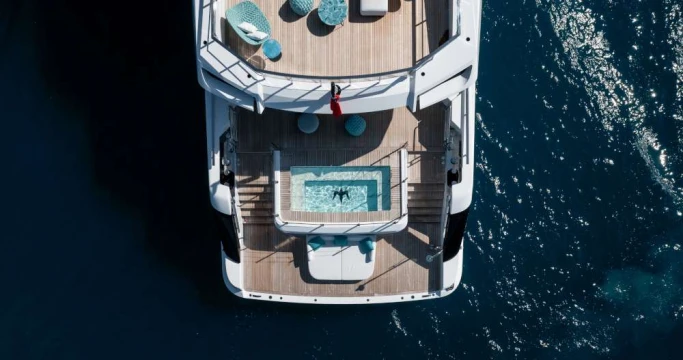
EB - The pool stopped being a purely scenic feature a long time ago: it is a space dedicated to wellbeing, relaxation and socialising - an integral part of the onboard experience. Owners want to enjoy the same level of comfort aboard their yacht as they do in a luxury residence, and this is leading to increasingly sophisticated wellness areas. Just consider the complete wellness experiences now being designed onboard, incorporating saunas, hammams, experience showers, treatment rooms and massage areas.
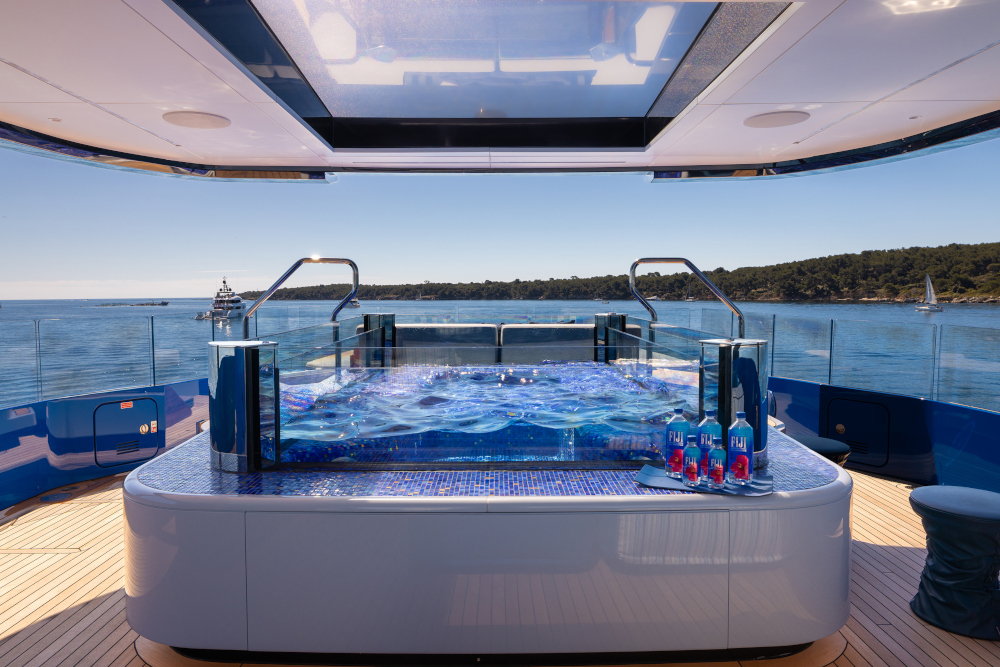
PM - In the superyacht world, every centimetre matters and almost nothing is standard. How does your approach change when you have to deal with irregular spaces, unusual geometries and structural constraints?
EB - That is exactly how we are accustomed to working. We start with the available space, rather than with a predefined product. In yachting this becomes even more important - I would say essential: every volume has to be optimised, every shape carefully studied and every detail coordinated with the yacht’s general arrangement. The aim is to create a pool that is fully integrated into the yacht’s architecture and capable of meeting both the desired aesthetic standards and the technical requirements of the system.
PM - How important is the dialogue with naval designers, interior designers and shipyard technical departments when integrating a swimming pool without compromising the yacht’s weight, volumes and stability?
EB - It is crucial. A project of this kind can only succeed through continuous collaboration between all the professionals involved. A swimming pool affects aesthetic, structural and systems-related aspects, so discussions with naval architects, designers and technical departments begin at the earliest stages of development. Our role is to find the best possible balance between design, functionality, safety and technical feasibility, bringing our experience and know-how to the project.
PM - Have you encountered aesthetic or design requests that initially seemed impossible to achieve but that you ultimately managed to turn into a concrete solution?
EB - Designers often propose very ambitious solutions involving unusual geometries, visual effects or complex integrations. Our approach is never to begin by saying, “it can’t be done”, but rather to find a way to make it possible. Through engineering, materials research and the development of dedicated solutions, we have succeeded in creating pools that initially appeared extremely difficult to realise, while respecting both the original design concept and the technical requirements of the marine environment.
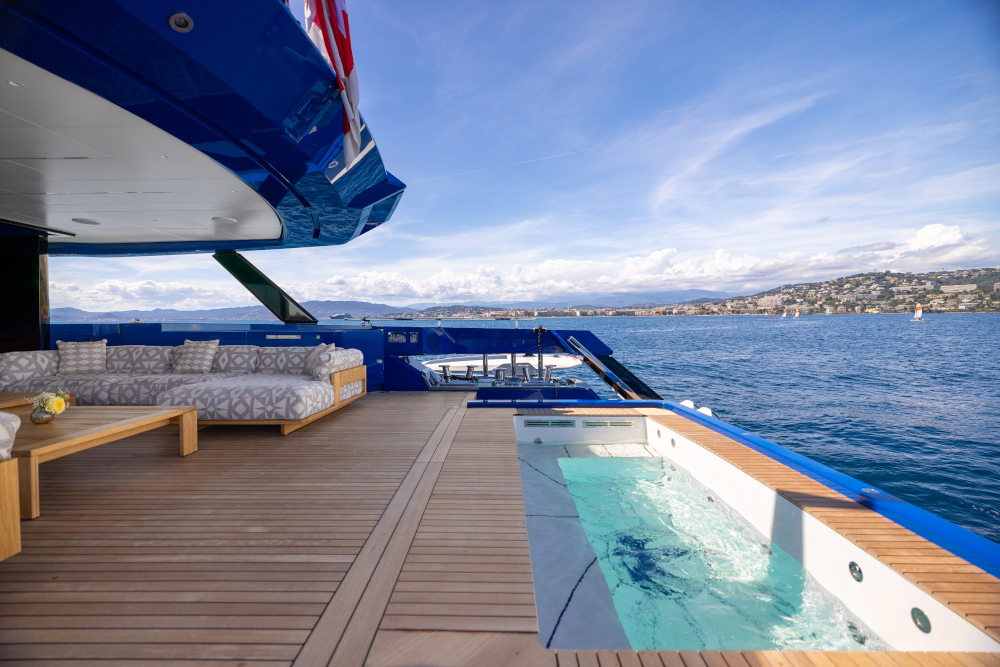
PM - In the superyacht sector, the boundaries between swimming pools, spas, beach clubs and wellness areas are becoming increasingly blurred. Are you seeing growing crossover between these different spaces?
EB - Absolutely. Today, complete integrated wellness areas are being designed in which swimming pools, whirlpools, relaxation areas, water features and beach clubs interact with one another. They are no longer separate elements, but part of a single sensory experience. This evolution requires specific expertise and a multidisciplinary design approach in which technology, design and comfort must coexist harmoniously.
PM - Are there clear differences between the requirements of European, Middle Eastern and American owners?
EB - Every market has its own characteristics and interprets the onboard pool differently, according to the style, requirements and philosophy of each project. Beyond geographical differences, however, there is one common factor: the demand for exclusive, reliable and completely bespoke solutions.
PM - A pool installed aboard a yacht has to withstand acceleration, vibration, changes in load and continuous motion. How do you redesign a swimming pool system for these conditions?
EB - We start from completely different assumptions compared with a conventional swimming pool. Every component is developed taking into account the dynamic stresses typical of navigation: specific structural systems are engineered, materials suitable for the marine environment are selected, and systems are designed to deliver high performance even under changing conditions. It is an integrated engineering process that requires constant dialogue with the shipyard and all the technical professionals involved.
PM - What are the main technical challenges today regarding the safety of a swimming pool aboard a superyacht?
EB - Safety is an absolute priority and involves several different aspects: the correct management of water while underway, the structural integrity of the entire system, and the safety of the equipment and components in contact with the water. This also includes the use of certified materials suitable for the marine environment, the design of reliable, efficient and easily maintainable systems, and compliance with the standards established by classification societies and international regulations. The real challenge is to combine safety, performance and aesthetics without allowing any one of these three aspects to prevail over the others.
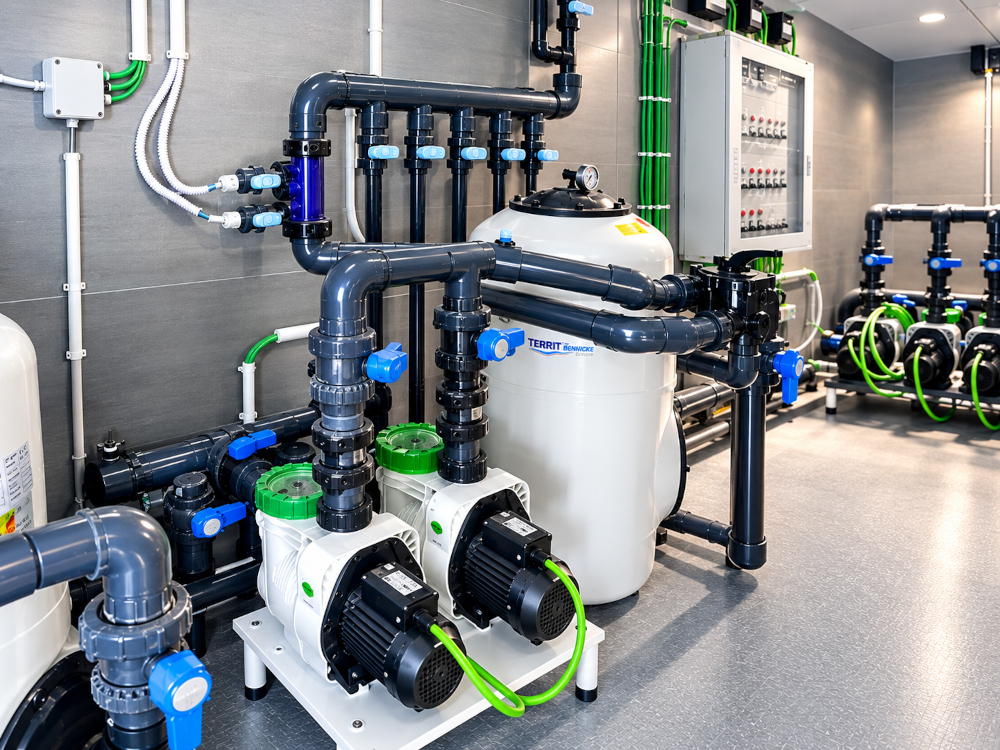
PM - How much do materials, surface treatments and filtration systems affect the durability and reliability of a swimming pool in the marine environment?
EB - They are decisive. The marine environment is extremely aggressive and requires materials specifically selected to withstand corrosion, saltwater, humidity and continuous mechanical stresses. Surface treatments and filtration systems also play a key role: they ensure water quality and long-term reliability, reduce maintenance requirements and preserve the system’s performance over many years.
PM - What are the main differences between a pool designed for freshwater and one intended to use seawater?
EB - They are substantial. Seawater requires specific choices in terms of both materials and system configuration: components, seals, treatment systems and hydraulic circuits all have to withstand greater chemical aggressiveness and high salinity levels. The objective remains the same: to deliver the same quality of experience without compromising reliability or durability.
PM - Do owners ever ask you to recreate onboard the same sensations and atmosphere they enjoy in their private residences?
EB - Increasingly so. Many owners want to reproduce onboard the same design language, the same materials and the same sense of comfort and wellbeing that characterise their private residences. In some cases, the yacht project becomes almost a natural extension of the home, with a strong continuity between the two environments. Designers play a fundamental role in translating the owner’s wishes into a tangible project: our task is to turn that vision into reality within a completely different environment - the marine environment - where every decision has to address very specific technical, structural and functional constraints. The real challenge is to preserve the identity of the project and the sensations sought by the owner, while transforming them into a technically reliable solution that is fully integrated and suited to life onboard.
©PressMare - All rights reserved