Superyachts: A More Mature Market Driven by Selectivity and New Equilibriums
Looking at Fraser’s Global Superyacht Review 2026 as a whole, the most significant finding is not a single metric, but the overall direction of the market. Yachting is not slowing down; it is changing in nature.
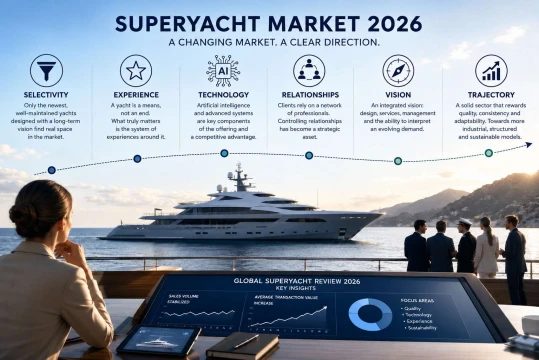
Following the post-pandemic expansion, characterised by sustained and partly impulsive demand, the industry has entered a more mature phase. Transaction volumes are stabilising, while the average value of sales continues to increase. Purchasing decisions are taking longer, becoming more considered and forming part of a broader long-term vision among yacht owners.
This marks the end of a relatively straightforward growth cycle, driven largely by the arrival of new buyers and immediate demand. Today, the market operates on different foundations—more complex, more selective and less predictable.
The first defining characteristic is selectivity. Not every yacht meets today’s market expectations, and not every listing finds buyers with the same ease. More recent yachts, well-maintained vessels and projects designed with lifecycle considerations in mind are favoured over older or less updated products. The second key aspect is the growing importance of the experience. As highlighted in previous analyses, the yacht is no longer viewed as the ultimate objective, but as a means of enabling a broader lifestyle. It has become a platform through which owners create integrated experiences that connect seamlessly with other segments of the luxury world. As a result, value increasingly shifts from the asset itself to the ecosystem surrounding it. The third element concerns the role of technology. Artificial intelligence and advanced management systems are no longer optional features but increasingly important components in shaping the market offering. Companies capable of integrating these technologies effectively will gain a significant competitive advantage.
Finally, the industry’s relationship model is evolving. Clients no longer interact with a single point of contact, but with a network of professionals—including brokers, family offices, captains and specialised consultants—who all contribute to the decision-making process. In this environment, managing and maintaining those relationships becomes a strategic asset.
For shipyards and the wider supply chain, this scenario requires a reassessment of priorities. Building a high-quality yacht is no longer enough. Success increasingly depends on a broader vision capable of integrating design, services, lifecycle management and the ability to interpret an ever-evolving demand. The superyacht market remains fundamentally strong, but it has become less forgiving. It rewards quality, consistency and adaptability while penalising those who remain tied to static business models or overly simplistic interpretations of customer demand.
In this respect, Fraser’s report does more than describe the current state of the market—it outlines its direction. The industry, while preserving its aspirational appeal, is gradually adopting more structured, industrial and ultimately more sustainable business models. Rather than representing a phase of expansion or contraction, the current period appears to be one of redefinition. Yachting is consolidating its industrial dimension while reshaping its relationship with clients. It is this balance that will largely determine the sector’s evolution over the coming years.
Cristina Bernardini
©PressMare - All rights reserved