
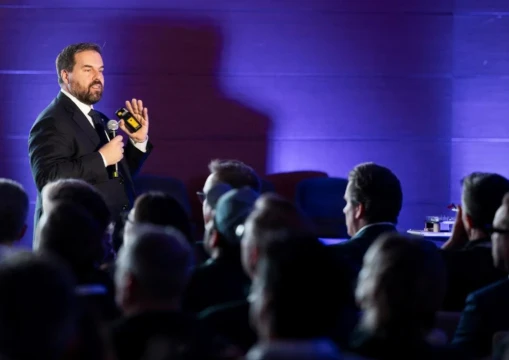
Sebastiano Fanizza during the panel “Redefining Luxury, Episode 2”, organized by Smart Interiors Horizon at SEAQUIP Milano 2026
Sustainability in yachting. Fanizza: design and supply chain are decisive
During the panel “Redefining Luxury, Episode 2: From ambition to implementation - How Italian excellence is shaping the path toward responsible interiors”, organized by Smart Interiors Horizon at SEAQUIP Milano 2026, a clear perspective emerged: in yachting, sustainability is прежде всего a matter of choices, even before technology.
We discussed this with Sebastiano Fanizza, Founder of Elessargery, who offers a direct view on responsibility, supply chain and market dynamics highlighted during the panel.
PressMare – In the path toward greater sustainability, how important is the role of the owner?
Sebastiano Fanizza – Less than one might think, because sustainability primarily depends on those who design, select and build. It does not necessarily have to start from the owner.
A yacht is the result of a complex supply chain, made up of suppliers, designers and subcontractors. The shipyard acts as a general contractor: it does not produce everything directly, but selects who does. And that is precisely where responsibility lies.
You can choose a supplier that operates without standards, or one that respects safety, people and processes. That, too, is sustainability.
PM – So the change is more structural than “value-driven”?
SF – Exactly: it is not about convincing the client with sustainability, but about designing better.
If I introduce UV-protected glass, I reduce air conditioning consumption. That means greater comfort and lower operating costs. Sustainability is a consequence, but not necessarily the first argument I present to the client.
For example, I sold an air conditioning system that, on a 67-metre yacht, allows savings of over half a million euros in fuel per year. I did not present it as a sustainable solution, but as an efficient one.
The point is this: the narrative changes depending on the interlocutor and their interests. The result, however, remains.
PM – So it is more about how it is communicated than what is done?
SF – It is about the responsibility of those proposing the solution. Salespeople must know what they offer, but they do not decide what is produced. Decisions are made upstream, in design and in the selection of the supply chain.
If that phase is managed properly, the commercial side is already offering a product where sustainability is embedded naturally.
PM – Looking at the supply chain, where does change really start?
SF – In demand. If the market starts asking for sustainable products, supply adapts immediately.
We have seen this in other sectors, such as automotive: when demand changes, the market changes.
If, on the other hand, only supply is pushed without real demand, the risk is that those products are not adopted. At that point, companies stop investing in them.
PM – What role do materials and technical choices play in this scenario?
SF – They are central, but must be interpreted correctly. A material can be sustainable, but first it must be of quality: it must work, last and meet a real need.
Sustainability is a feature in the background. The client buys the product because it is appealing, performs well and is suitable. Then, if interested, they discover that it is also sustainable.
PM – And certifications? How much do they really matter today?
SF – Not enough. In my experience, most projects look first at cost, then aesthetics, and only afterwards at certifications.
Moreover, there are many different certifications, often difficult to interpret in a unified way, and this fragmentation does not help the decision-making process.
It would be useful to move towards a more integrated system, a kind of overall yacht certification that includes materials, processes and supply chain. Today there are initiatives in this direction, but they are still partial.
PM – During the panel, you also spoke about ESG as a system. What role do the social and governance components play?
SF – They are very important, even if they are less discussed. Reducing sustainability to the environmental dimension alone is a mistake, because a product is truly sustainable only if it is supported by a solid supply chain, clear standards, reliable processes and proper treatment of people.
The “S” in ESG concerns work: skills, safety, operating conditions, continuity and quality along the entire value chain. The “G” concerns how a company makes decisions, selects partners, controls processes and takes responsibility for what it brings to market.
In yachting, this is central, because a yacht is not created by a single actor, but by a complex ecosystem of highly specialized skills. If ethics, organizational solidity, industrial culture and responsibility are missing in the supply chain, the final result is affected, even when the product appears excellent.
Sustainability in yachting is not something to be introduced, but to be managed in a comprehensive way. The tools already exist, as do the solutions. The difference lies in the ability to integrate them along the entire supply chain, bringing together environment, people and decision-making responsibility. Without E, S and G working together, sustainability remains only partial.
©PressMare - All rights reserved